
Tapeta vs Fibresand at Southwell: A Surface That Rewrote the Form Book
Best Horse Racing Betting Sites – Bet on Horse Racing in 2026
Loading...
If you backed winners at Southwell before December 2021 and assumed the same logic would carry over, you learned an expensive lesson. The switch from Fibresand to Tapeta did not just change the colour of the track — it changed which horses won, how races were run and what mattered in the form book. The old Southwell and the new Southwell are, for betting purposes, different racecourses.
Fibresand had been in place since 1989, making Southwell the last track in Britain to use the surface. Its replacement with Tapeta was part of a broader investment by Arena Racing Company, owners of four of the six all-weather tracks in the UK. The first race on the new surface took place on 7 December 2021, with the Charlie Hills-trained Carausius going into the record books as the inaugural winner.
For punters, the question was immediate: what still works, and what needs throwing out? Four years on, we have enough data to answer.
How Fibresand Raced: Deep, Slow and Kickback-Heavy
Fibresand was a mixture of silica sand and synthetic fibres, and it rode like nothing else in British racing. The surface was deep — significantly deeper than Polytrack or Tapeta — which made it physically demanding. Horses needed genuine stamina even over sprint distances, because every stride required more effort than it would on a conventional all-weather track. Race times were slower, and the finishing order often reflected raw endurance as much as talent.
The kickback was notorious. Fibresand threw up a wall of sand that punished any horse racing behind the leaders, particularly in sprints where the field was tightly bunched. This gave a structural advantage to front-runners and prominent racers — not because they were necessarily the best horses, but because they avoided the worst of the interference. Kieren Fallon once remarked that he disliked the course because the Fibresand stuck to his hair. His strike rate at the venue — around 9% — suggested the surface disliked him right back.
From a betting perspective, Fibresand created reliable patterns. Low draws were poor in five-furlong sprints. Front-runners overperformed. Horses that had proven Fibresand form were almost essential — form on other all-weather surfaces was a weak guide because no other track in Britain used the same material. The result was a course where a small group of specialists dominated, some of them racking up extraordinary records. Tempering won 22 times at Southwell; Kylkenny managed 17. These were not top-class horses — they were Fibresand specialists who would have been nothing special anywhere else.
The Tapeta Difference: Speed, Drainage and Fairness
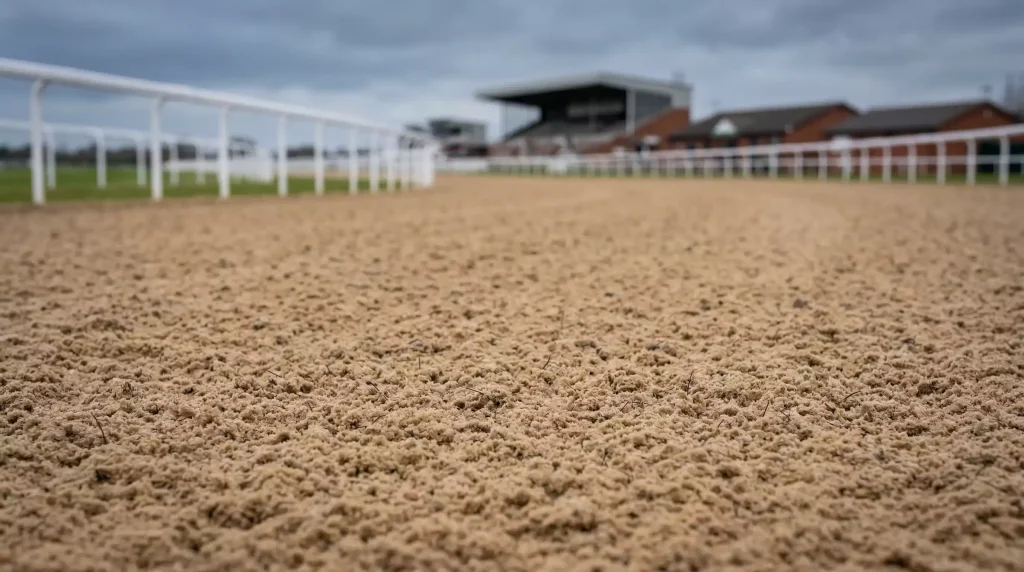
Tapeta is a blend of sand, wax and fibre, developed by former trainer Michael Dickinson and already in use at Wolverhampton and Newcastle when Southwell adopted it. The surface is shallower than Fibresand, produces dramatically less kickback and drains vertically rather than allowing water to pool. Champion trainer John Gosden endorsed the switch, saying the Tapeta surface was “both safe and true” and comparing Southwell’s configuration to top American racecourses.
The practical effects were visible from the first meeting. Race times dropped. Five-furlong sprints that had been clocking 63 to 64 seconds on Fibresand came in around 60 to 61 on Tapeta. The gap narrowed at longer distances but remained measurable — roughly one to two seconds per mile. Horses that had been held up in rear found they could close gaps that Fibresand’s kickback had made impossible. The front-runner bias weakened. Not eliminated — pace still matters on any course — but weakened to the point where it no longer functioned as a standalone betting system.
Draw bias flattened too. The inside rail, which had been dead ground on Fibresand due to uneven sand distribution, now rode at a similar speed to the centre and outside. Tapeta’s drainage system is designed to move water through the surface uniformly, preventing the kind of localised deterioration that created rail bias on the old track.
2024 Resurfacing After the Flood
The Tapeta that runners race on in 2026 is not quite the same Tapeta that was installed in 2021. Southwell suffered significant flooding in 2023, causing enough damage to require a full resurfacing of the all-weather track in 2024. The rebuilt surface uses the same Tapeta material but benefits from improvements to the underlying drainage infrastructure — a response not just to the flood damage but to lessons learned from how the original installation bedded in over its first two years.
For bettors, the 2024 resurfacing is an important data-point. It means that race results from early 2022, when the original Tapeta was still settling, are less representative of current conditions than results from late 2024 onwards. A horse that struggled at Southwell in the spring of 2022 may have been running on a surface that rode differently from the one it would encounter today. Course-and-distance form should be weighted towards the most recent 18 months rather than treated as a homogeneous four-year block.
The resurfacing also resets some of the minor biases that had begun to develop as the original surface aged. Fresh Tapeta tends to ride at its most uniform, with bias emerging gradually as the material wears unevenly through heavy use. With the track now in relatively early life, conditions should be as fair as they are likely to get for the next couple of seasons.
Betting Implications: Old Form vs New Form
The most important principle for anyone betting at Southwell in 2026 is this: pre-December 2021 form at this course is functionally worthless. A horse that won three times on Fibresand has no proven aptitude for Tapeta — they are different surfaces with different demands. The specialists that thrived in the Fibresand era have largely retired, and the horses that dominate now are a different profile: quicker, more versatile and less reliant on front-running tactics.
Form from other Tapeta tracks — Newcastle and Wolverhampton — is a much better guide than old Southwell form. A horse with solid Newcastle form running at Southwell for the first time is a more reliable proposition than one with five Fibresand wins returning to a track it no longer recognises. This is a significant shift from the Fibresand era, when cross-surface form was nearly useless because no other track offered a comparable experience.
There are still specialist angles to mine. Horses with strong recent Southwell Tapeta form — meaning multiple runs in the last 12 months on the resurfaced track — carry an edge in lower-class races where the field contains several track debutants. Trainers who have adapted their approach to the new surface, running horses they would not have sent to Fibresand, are worth monitoring. The old guard of Southwell trainers has been partly replaced by yards that target Tapeta across multiple venues.
Speed figures from Southwell now correlate more closely with those from Newcastle and Wolverhampton than they did in the Fibresand era, when Southwell existed in its own statistical universe. This makes cross-track comparison easier and more reliable — a genuine improvement for anyone trying to assess a horse’s all-weather capability rather than its aptitude for one peculiar surface.
The surface changed. The form book had to change with it. Anyone still clinging to Fibresand-era assumptions is betting on a racecourse that no longer exists.