
Tapeta Surface Explained: Composition, Behaviour and Betting Impact
Best Horse Racing Betting Sites – Bet on Horse Racing in 2026
Loading...
Tapeta surface is the synthetic material that three of Britain’s six all-weather racecourses run on — Southwell, Newcastle and Wolverhampton — yet most punters could not tell you what it is made of, why it was chosen or how its physical properties affect race outcomes. That gap between widespread use and limited understanding is exactly where betting edges hide. If you know what the surface does and why, you can read form more accurately than someone who treats all synthetic tracks as interchangeable.
Developed by former trainer Michael Dickinson and Joan Wakefield at their Tapeta Footings operation, the surface has been through multiple iterations. The current version — broadly referred to as Tapeta 10 — is the product of more than two decades of research and refinement. It is not a natural material and it is not dirt. It is an engineered product with specific mechanical properties designed to achieve specific outcomes: safety, consistency and fairness. Understanding what that engineering produces is the starting point for anyone serious about all-weather form analysis.
Materials: Sand, Wax, Fibre and How They Interact
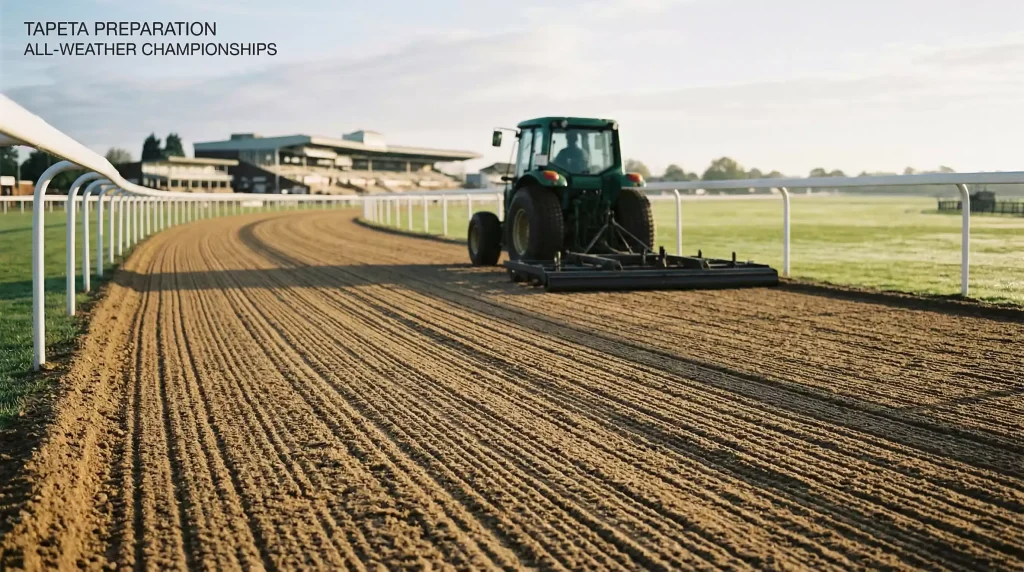
Tapeta is a composite of three primary materials: sand, wax and synthetic fibre. The sand provides the structural base — the part you see and the part the horse runs on. The wax coats the sand grains, binding them together and giving the surface its characteristic slight tackiness underfoot. The synthetic fibres are distributed throughout the mixture, acting as reinforcement that prevents the material from compacting too tightly or separating under the force of galloping hooves.
The proportions and specifications of these ingredients are proprietary, but the broad principle is straightforward. The wax-coated sand creates a surface that is firm enough to support a horse at speed without being hard enough to cause concussive injury. The fibres ensure the material holds together even after repeated harrowing and heavy use, maintaining a consistent depth and texture across the racing surface. Think of it as a carefully calibrated middle ground between a natural turf course — which is soft, variable and weather-dependent — and a concrete road, which is flat, uniform and unforgiving.
The practical consequence for bettors is that Tapeta produces a racing surface with much less variation than turf. There is no equivalent of the going changing from good to heavy mid-meeting. The surface does not cut up the way grass does when a dozen races have been run on it. This consistency means that speed figures from one Tapeta meeting to the next are more directly comparable than turf figures, where the going can change everything. A horse that clocked 60.2 seconds for five furlongs at Southwell last month will encounter a surface riding very similarly when it returns next week — something that can never be said with confidence about turf.
Drainage and Weather Resilience
The defining engineering achievement of Tapeta, from a racecourse management perspective, is its drainage. The surface is built on a graded drainage layer that moves water vertically through the material rather than allowing it to pool on the top or run off to the sides. Rain passes through Tapeta and exits below, which means the surface can absorb significant rainfall without becoming waterlogged. This is why all-weather meetings at Tapeta tracks are rarely abandoned due to weather — a significant commercial advantage for racecourse operators and a significant practical advantage for bettors who want to plan their week with confidence.
The drainage system also contributes to the elimination of localised bias. On a turf track, rain can pool in hollows or along the rail, creating strips of faster or slower ground that riders learn to exploit. On a well-maintained Tapeta surface, the uniform drainage means the rail rides at a similar speed to the centre and outside of the track. This is why draw bias at Tapeta venues tends to be minimal — the surface does not deteriorate unevenly in the way that natural ground does.
Temperature resilience is the other side of the equation. In cold weather, turf freezes and meetings are abandoned. Tapeta’s wax component lowers its freezing point, allowing racing to continue in conditions that would shut down a turf course. In extreme cold — prolonged sub-zero temperatures over several days — Tapeta can still freeze, and Southwell has occasionally lost meetings to frost. But the threshold is materially lower than for turf, which is why the all-weather programme is concentrated in winter: it exists precisely to keep racing going when turf cannot.
Safety Record: Injury Rates on Tapeta vs Other Surfaces
The strongest argument for Tapeta is the safety data. According to research cited by Tapeta Footings, horses working on their surface experience approximately 50% less concussive impact on their limbs compared to other racing surfaces. This finding draws on the US Jockey Club’s Equine Injury Database covering the period 2009 to 2016 and reflects the cushioning effect of the wax-and-fibre composition.
Broader injury statistics tell a consistent story. Data from 2015 showed 1.18 fatalities per 1,000 starts on synthetic surfaces in North America, compared with 1.22 on turf and 1.78 on dirt. While those numbers are not specific to Tapeta alone — the synthetic category includes Polytrack and other materials — they demonstrate the general safety advantage of engineered surfaces over natural ones.
For bettors, the safety data matters in an indirect but meaningful way. Safer surfaces mean fewer breakdowns, which means more horses complete their races, which means more data to work with. A horse that might have suffered a career-ending injury on dirt or a hard turf track can continue racing on Tapeta, building up the kind of multi-run form record that makes handicapping more reliable. The legendary gambler Barney Curley summed up the bettor’s perspective simply: “Have no fear betting on Tapeta. It is as reliable and consistent as turf and a lot more practical than dirt.”
What Tapeta Means for Form Analysis
The betting implications of Tapeta’s properties are concrete. First, form is more portable between Tapeta tracks than between different turf courses. A horse that performs well at Southwell on Tapeta has a higher likelihood of reproducing that form at Newcastle or Wolverhampton than a horse moving between, say, Chester and Newbury on turf — because the surface variable is controlled. Cross-track form analysis on the Tapeta circuit is one of the most underused tools in all-weather betting.
Second, the consistency of the surface means that trainers can plan campaigns with greater confidence. When a trainer targets a horse at Southwell knowing the surface will ride the same as it did three weeks ago, the preparation can be more precise. This forward planning shows up in the form book as horses arriving at Southwell in better condition and with clearer objectives than those sent to turf courses where the going is a gamble until raceday morning.
Third, the reduced variation means that pure speed figures — raw time relative to standard — are more trustworthy on Tapeta than on turf. Speed-figure-based selection methods that struggle with the noise of changing ground conditions on turf can perform better on Tapeta, because the surface holds the main variable constant. If you have ever been frustrated by a speed figure that looked great but was produced on ground that no longer exists, Tapeta largely solves that problem.
What Tapeta does not do is make every horse equal. It does not eliminate class differences, it does not remove the advantage of superior training and it does not make pace irrelevant. It creates a level playing field in terms of surface conditions, and that clarity is precisely what the thoughtful bettor can exploit.