
Southwell 5-Furlong Sprint Tips: Why This Course Rewards Speed
Best Horse Racing Betting Sites – Bet on Horse Racing in 2026
Loading...
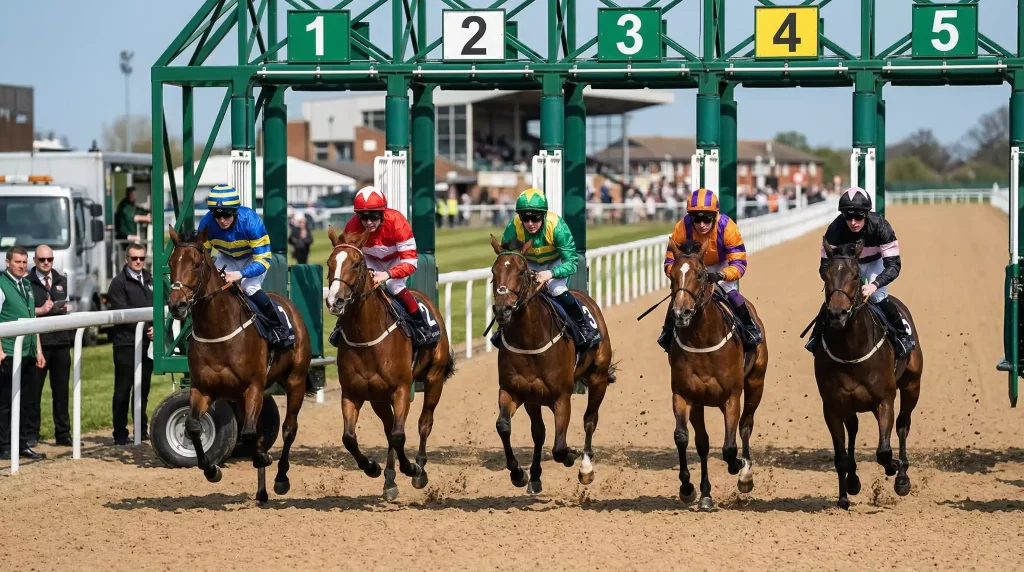
Southwell 5-furlong sprint tips require a different mental model from anything else on the card. Most races at this Nottinghamshire track run on a left-handed oval, where bends, pace positioning and tactical riding all influence the result. The five-furlong trip sidesteps all of that. It is run on a straight chute — a spur that feeds directly into the home straight — and the entire race unfolds in around sixty seconds with no turns, no tactical waiting and very little room for error.
That configuration creates a race type where raw speed matters more than at any other distance on the course. Horses that lead or race prominently are not just preferred — they are structurally advantaged by the layout. The home straight at Southwell is about three furlongs long, and in a five-furlong race, runners enter it barely two furlongs in. There is no long run to the finish where closers can wind up. If you are not near the front by the halfway mark, the race is effectively over.
The BHA Racing Report records an average flat field size of 8.90 runners in 2025, down from 9.14 in 2024 — and sprint fields at Southwell tend to sit at or slightly above that average. Understanding how the straight-course layout interacts with pace, draw and field size is the foundation of any serious sprint handicapping at this venue.
The Straight Chute: Layout and Rail Position
Southwell’s five-furlong chute is the second-longest straight all-weather sprint course in Britain, behind only Newcastle’s extended straight. It branches off from the back straight, running broadly south-to-north, and joins the oval just before the three-furlong marker. From that junction to the finish, horses race towards the grandstand in a straight line.
What matters for betting is the geometry. Because the chute is narrow relative to the oval, runners do not fan out to the same degree you see in round-course sprints. The rail is close on both sides, and the centre of the track is proportionally more important. On the old Fibresand, the inside rail was notoriously dead — a strip of deeper, slower ground that punished anything drawn low. On the current Tapeta surface, this disparity has largely been engineered out through better drainage and more uniform composition, though a marginal centre preference persists in larger fields.
The camber is minimal. Unlike Epsom or Chester, where gradients play a role in how horses handle bends, the Southwell straight is flat. This means pace is the dominant variable — not terrain, not camber, not ground variation. Flat ground, straight line, sixty seconds. If you want to summarise Southwell sprint dynamics, that is it.
Pace Profiles: Speed Figures That Win at 5f
Speed figures are the currency of sprint handicapping, and at Southwell’s five furlongs they carry more weight than at any other distance on the card. The absence of bends removes the tactical dimension that muddies form at longer trips. A horse either ran fast or it did not — and sectional times, where available, make the picture even clearer.
On Tapeta, the standard five-furlong time at Southwell sits around 60 to 61 seconds in decent conditions for a mid-class handicap. Faster times — sub-60 — tend to appear in better-grade races or when a small field produces a clean, uncontested lead. Slower times, above 62 seconds, usually indicate a race run in a headwind, on a cold winter evening when the surface is riding a touch slower, or simply a weaker group of horses.
The key pattern is consistency. Horses that post speed figures within a narrow band across multiple starts at the trip — rather than one flashy number surrounded by mediocrity — are the ones to trust. A runner who clocked 58.8 once but typically runs 61-plus is not suddenly faster; it probably benefited from a collapsing pace or an underweight field. Look instead for the animal whose figures cluster tightly around 60.0 to 60.5, because that tells you it can reproduce the effort.
Front-runners and prominent racers dominate the speed-figure leaderboard at five furlongs here. Horses that race in the rear third of the field rarely post the fastest raw times, partly because they spend energy weaving through traffic on a narrow course and partly because the straight layout does not give them enough runway to close. When a hold-up horse does win a Southwell five-furlong race, it almost always coincides with a suicidal early pace set by two or three others — a scenario that is possible but not one to build a strategy around.
Stall Bias in 5f Sprints
The stall bias question at five furlongs is simpler on Tapeta than it was on Fibresand, but it has not vanished entirely. Post-2021 results show that in fields of ten or more, stalls 4 through 7 have a modest edge — roughly two to three percentage points above expected strike rate — while stalls 1 through 3 and stalls 10-plus perform close to neutral. In smaller fields, the effect disappears. This is a much flatter distribution than Fibresand ever produced, where low draws carried a genuine penalty.
The practical application is limited but real. In a large-field five-furlong handicap, all else being equal between two selections, the one drawn in stalls 4 to 7 has a fractional positional advantage at the break. It is not enough to override poor form or an unfavourable price, but it is enough to act as a tiebreaker when the formbook leaves you torn.
On Premier fixtures — which Southwell rarely hosts, given its classification as a Core venue — field sizes on the flat have averaged 11.02 runners in 2025. Core fixtures, where Southwell operates, average 8.65 according to the BHA Racing Report. At Southwell specifically, five-furlong sprint fields commonly sit between 8 and 12 runners, placing them squarely in the zone where a small draw effect can appear. Below eight runners, treat the draw as irrelevant.
Trainers and Jockeys to Note in Sprints
Sprint specialists tend to gravitate towards venues they know, and Southwell’s year-round flat programme makes it a magnet for all-weather-focused yards. Several trainers have built profitable niches in the five-furlong division here since the Tapeta switch, though the specific names shift from season to season as horses age and yards change profile.
What stays constant is the type of trainer who thrives. Smaller operations that run their horses frequently on the all-weather — rather than major National Hunt or turf-focused stables — tend to have the best Southwell sprint records. These trainers know the surface, know the pace dynamics and, crucially, place their horses in races where they have a realistic chance rather than entering at the wrong class level. When assessing a five-furlong race at Southwell, a trainer with fifteen or more previous sprint runners at the course in the current season is more informative than one sending a horse for the first time, regardless of reputation.
On the jockey side, the riders who excel in Southwell sprints share a common trait: decisiveness from the gate. The margin between a clean break and a slow one is amplified on a straight course with no bends to recover ground. Jockeys who consistently get their mounts out sharply from the stalls — something you can assess from replay footage or sectional data — are the ones to follow. A jockey with a 15% strike rate at Southwell overall may have a 20%+ rate in five-furlong races simply because their gate speed suits the format.
The practical advice: build a shortlist of trainer-jockey combinations that appear repeatedly in Southwell five-furlong races, track their results over a rolling three-month window, and pay attention when they team up with a horse that has course-and-distance form. That intersection — known trainer, sharp jockey, proven horse — is where the five-furlong edge lives.