
Southwell Racecourse History: 125+ Years of Racing in Nottinghamshire
Best Horse Racing Betting Sites – Bet on Horse Racing in 2026
Loading...
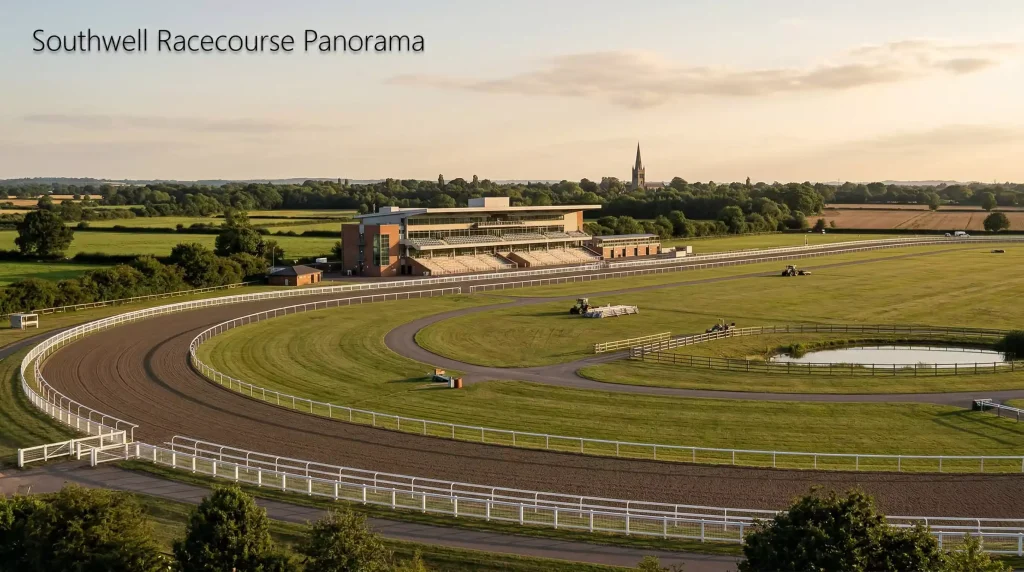
Southwell racecourse history stretches back further than most people realise and involves more reinvention than almost any other British venue. This is not a track that has stood still. It has moved location, pioneered a surface nobody else wanted, survived two devastating floods, installed floodlights, torn up its running surface and rebuilt it twice. The racecourse sitting in Rolleston in 2026 — with its Tapeta all-weather track, LED floodlights and 79-fixture annual programme — bears almost no physical resemblance to the informal racing ground where Nottinghamshire landowners matched their horses against each other in the mid-1800s. But the thread is continuous. Racing has happened here, in one form or another, for well over a century.
Understanding the history is not merely nostalgia. Each stage of Southwell’s development — the Fibresand experiment, the flood, the Tapeta switch — left marks on how the course rides and how form should be read. The past shapes the present, and at Southwell it shapes it more dramatically than at most courses.
Origins: Burgage Green and the Move to Rolleston
Informal horse racing in the Southwell area can be traced to the mid-1800s, when local landowners organised contests on open ground near the town. The earliest documented meetings took place at Burgage Green, a public space close to the centre of Southwell that offered enough flat ground for short-distance matches. These were not organised in the modern sense — no grandstand, no official programme, no regulated betting — but they drew enough spectators and interest to justify more permanent arrangements.
The move to the current site at Rolleston, roughly two miles east of the town, took place around 1898 when the first official race meetings were staged on land that allowed for a proper circuit. The location was chosen for practical reasons: it was flat, well-drained by the standards of the day and adjacent to Rolleston railway station, which gave racegoers from Nottingham and Newark a direct route to the course. That proximity to the railway line remains an advantage today — Rolleston station is still operational and sits next to the racecourse entrance.
For the best part of a century, Southwell operated as a modest turf track. It was neither a fashionable destination nor a particularly profitable one. The jump programme attracted local runners and small crowds, and the course survived largely on the loyalty of the Nottinghamshire racing community rather than on any claim to national significance.
1989: Britain’s First Fibresand Track
The event that transformed Southwell from an obscure turf venue into something genuinely unusual in British racing occurred in November 1989, when an all-weather Fibresand surface was installed on a new oval track built around the outside of the existing turf course. It was the first — and ultimately the only — Fibresand racing surface in Britain.
Fibresand was a mixture of silica sand and synthetic fibres that produced a deep, demanding surface with significant kickback. It bore little resemblance to the Polytrack that would later be installed at Lingfield and Kempton, or the Tapeta that now serves at Wolverhampton and Newcastle. It was closer in character to American dirt tracks than to any other British surface, and it divided opinion from the start. Some trainers embraced it as an opportunity to race their horses year-round; others considered it an unpleasant curiosity and never sent a runner.
The Fibresand era defined Southwell for over three decades. It created a unique ecosystem of course specialists — horses whose physical attributes and running styles were perfectly suited to a surface that existed nowhere else. It also made Southwell a place apart in the betting world, because form from other all-weather tracks was an unreliable guide to what would happen on the Fibresand. You either knew Southwell or you did not.
Course Legends: Tempering’s 22 Wins and Other Records
The Fibresand surface produced some of the most extreme course specialists in British racing history. Tempering holds the all-time Southwell record with 22 victories — a number that becomes even more remarkable when you learn that the horse won just once in 127 career starts away from the venue. This was not a good horse that happened to race at Southwell often. It was a horse that could barely win anywhere else.
Kylkenny compiled 17 wins at the course, and La Estrella retired at the age of fifteen with 16 Southwell victories to her name. China Castle and Elton Ledger each managed 16 as well. These were not headline horses — they would never appear in the Racing Post annual review — but they were royalty at Southwell, and their form lines on Fibresand were as bankable as anything in British racing.
Trainer Mark Johnston, who saddled more than 240 winners at the venue across his career, described Southwell as “faultless in terms of scale and layout,” adding that with a Tapeta surface it could become “an all-weather racetrack of the highest international standard.” Johnston’s long relationship with the course — spanning both the Fibresand and Tapeta eras — gave him a unique perspective on how the track’s identity evolved through successive transformations.
2012 Flood, 2019 Floodlights and 2021 Tapeta
Southwell’s modern history has been punctuated by dramatic physical events. In December 2012, severe flooding caused major damage to both the racing surface and the course buildings, forcing a temporary closure. Meetings were transferred to Wolverhampton and Lingfield while repairs were carried out, and the course reopened on 5 February 2013 with a seven-race flat meeting. The flood was a reminder of the course’s vulnerability to the River Greet, which runs close to the site — a vulnerability that would be tested again a decade later.
In 2019, the installation of state-of-the-art LED floodlights enabled Southwell to stage evening racing throughout the winter. The floodlights were among the most advanced of any racecourse in Europe, and they transformed the fixture list by allowing midweek evening meetings that previously would not have been possible during the short daylight hours of a British winter.
The most significant change came on 7 December 2021, when the first race was run on the new Tapeta surface that had replaced the Fibresand. Charlie Hills-trained Carausius became the first winner on Tapeta at Southwell — a milestone that marked the end of 32 years of Fibresand racing and the start of an entirely new era. The Fibresand, which had been renewed multiple times over its lifespan, was judged to have reached the end of its operational life. Arena Racing Company chose Tapeta as the replacement, aligning Southwell with the surface already in use at its Newcastle and Wolverhampton venues.
Then came another flood. In 2023, severe weather once again damaged the track, requiring a full resurfacing of the Tapeta in 2024. The rebuilt surface incorporated improvements to the underlying drainage infrastructure, and the track that horses run on today is effectively in the early stage of its operational life — riding at its most uniform and consistent.
Arena Racing Company and the Modern Era
Southwell is owned and operated by Arena Racing Company, the largest racecourse group in Britain. ARC manages 16 racecourses, accounts for 39% of all British racing fixtures and controls four of the six all-weather tracks in the country — Southwell, Newcastle, Wolverhampton and Lingfield. The company is also a significant shareholder in Sky Sports Racing, which broadcasts to approximately 14 million homes.
Under ARC’s stewardship, Southwell has evolved from a Fibresand curiosity into a mainstream all-weather venue. The investment in Tapeta, floodlights and drainage infrastructure has positioned the course as a year-round operation capable of staging racing in conditions that would shut down most turf tracks. The 79 fixtures confirmed for 2026 make Southwell one of the busiest racecourses in the country — a venue that hosts more racing than many courses with considerably higher public profiles.
The history of Southwell is not a gentle arc. It is a series of sharp turns — new surfaces, new lights, new floods, new rebuilds. Each turn reshaped the course and reshaped the form book. For bettors, the lesson is that Southwell has never stood still, and treating it as a fixed entity is a mistake. The course you bet on today is the product of decisions made decades ago and disasters weathered far more recently. Know the history, and the present makes more sense.