
Southwell Racecourse Guide: Everything You Need for a Day at the Track
Best Horse Racing Betting Sites – Bet on Horse Racing in 2026
Loading...
Southwell Racecourse Guide: Everything You Need for a Day at the Track
Southwell racecourse sits on the edge of a quiet Nottinghamshire village, roughly twenty minutes east of Mansfield and a world away from the pageantry of Royal Ascot. It is not a track that sells itself on tradition or spectacle. It sells itself on volume, consistency and year-round action. With 79 confirmed fixtures for 2026, Southwell stages more racedays than the vast majority of British courses, offering punters an almost weekly opportunity to study form, test systems and refine their approach to all-weather racing.
That fixture count is not an accident. The all-weather surface means Southwell rarely loses a meeting to weather — no waterlogged ground, no frozen turf. For bettors who take a structured approach, this regularity is valuable. It creates a stable dataset, recurring conditions and a rhythm that turf-only courses simply cannot match. Whether you are travelling to the course for a midweek afternoon card or watching a floodlit meeting from your sofa, knowing how Southwell is laid out, how it rides and what to expect when you arrive makes a material difference to both enjoyment and judgement.
This guide covers the physical racecourse in detail: track dimensions, the Tapeta surface, the turf course used for National Hunt, the fixture calendar, evening racing under floodlights, travel logistics and on-course facilities. It is not a betting strategy piece — that lives elsewhere — but understanding the venue is the first step toward understanding the racing.
Southwell is owned by Arena Racing Company, which operates 16 racecourses across Britain and runs four of the six all-weather tracks in the country. ARC manages roughly 39% of all British racing fixtures — a market share that gives the group significant influence over scheduling, prize money allocation and the day-to-day racing product. For Southwell, that corporate backing translates into consistent investment in the surface, facilities and floodlighting, even if the venue itself retains a distinctly unpretentious character. It is a workhorse course, and it knows it.
Track Dimensions and Configuration
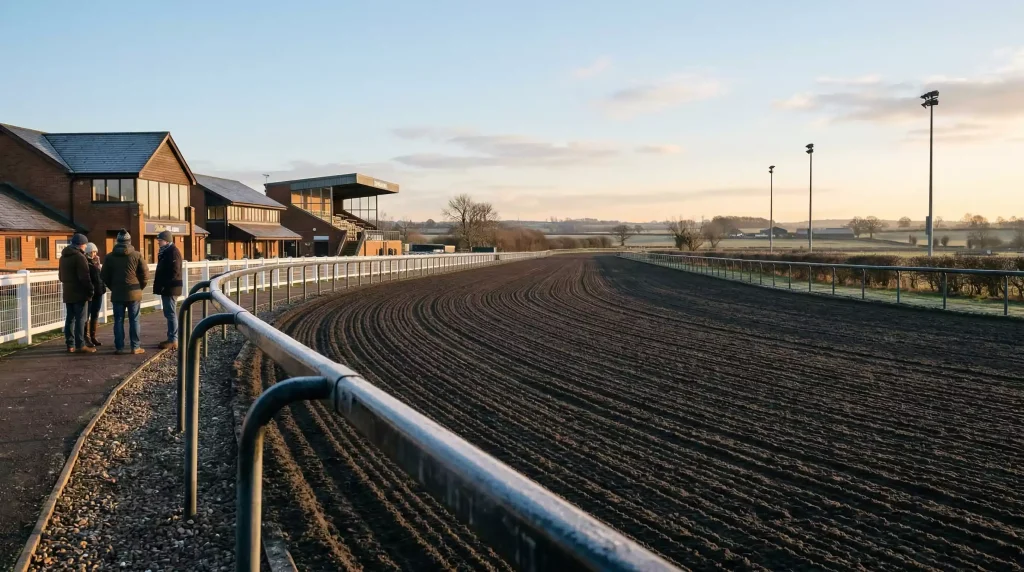
Southwell’s all-weather track is a left-handed oval of approximately one mile and two furlongs in circumference. The turns are relatively sharp, especially the bend into the home straight, which rewards handy, well-balanced horses over long-striding gallopers who need time to find their rhythm. The run-in from the final bend to the winning post is around three furlongs — long enough for a well-timed challenge but short enough that front-runners who have stolen a soft lead can cling on.
The track sits on a broadly flat plane with only gentle undulations. There is no significant uphill finish like Cheltenham’s or Sandown’s final climb, and that absence of gradient contributes to Southwell’s reputation as a course where pace and positioning tend to outweigh raw stamina. Races over five furlongs use a straight chute that joins the main oval, meaning sprinters avoid the bends entirely. Beyond five furlongs, all trips involve at least one turn, and at distances of a mile and beyond, the field negotiates the full loop.
For those unfamiliar with left-handed tracks: jockeys ride in an anticlockwise direction. This matters because some horses are known to perform markedly better on one hand than the other. Form students who notice a horse has won multiple times at left-handed venues such as Wolverhampton, Lingfield or Chester, then flopped right-handed at Kempton, should take that directional preference seriously when it reappears at Southwell.
The width of the track is standard for an all-weather oval, accommodating fields of up to sixteen runners without excessive bunching. However, on tighter bends, draws and early positioning become more influential — a factor we will touch on only briefly here, since it falls squarely into betting strategy territory. What matters for the racecourse guide is that the configuration rewards speed, tactical nous and course familiarity. Horses that handle the bends well, break cleanly and settle into position early are disproportionately represented in the Southwell winner’s enclosure.
The starting stalls are positioned at various points around the oval depending on the trip. For six-furlong races, the start is on the back straight approaching the far turn. For a mile, runners begin on the far side and complete almost the full circuit. The stalls positions are clearly visible from the grandstand at shorter distances, though the far-side starts can be difficult to follow with the naked eye — binoculars or the big-screen replay are useful here. If you are watching from home, the head-on camera used at Southwell gives a reasonable sense of positioning through the early stages.
The Tapeta Surface: What It Means for Horses and Punters
Until December 2021, Southwell raced on Fibresand — a surface unique in Britain and widely regarded as an acquired taste. Fibresand was deep, holding and produced a distinctive kickback that many horses (and jockeys) found uncomfortable. It created its own ecosystem of specialists: horses that loved the deep going and thrived at Southwell while failing everywhere else. The form book was, in a sense, its own island.
The switch to Tapeta changed that dynamic. Tapeta is a blend of silica sand, wax and fibres, designed by Michael Dickinson — a former champion jumps trainer turned surface engineer. The material drains rapidly, maintains a consistent cushion and, according to Tapeta Footings, reduces concussive impact on horses’ limbs by roughly 50% compared with other surfaces. That statistic comes from research by Dr. Pratt, who spent over two decades studying the mechanical properties of racetrack surfaces.
For racegoers and television viewers, the most visible change was cosmetic: Tapeta is darker than Fibresand and produces far less kickback. For punters, the change was fundamental. Race times quickened, front-runners no longer died in the deep ground as routinely, and horses with turf or Polytrack form suddenly had relevant credentials at Southwell. The old Fibresand form book became largely redundant.
Southwell’s first winner on Tapeta was Carausius, trained by Charlie Hills, on 7 December 2021. In the years since, the surface has bedded in and attracted a broader range of trainers who previously avoided the course. John Gosden, one of the sport’s most respected figures, described the Tapeta surface as “both safe and true” and compared Southwell’s configuration favourably to top American racetracks — Mark Johnston, who had already accumulated over 240 winners at the venue on Fibresand, called Southwell “faultless in terms of scale and layout” and said the Tapeta installation could make it “an all-weather racetrack of the highest international standard.”
In 2023, severe flooding in Nottinghamshire damaged the track, and the Tapeta surface was refurbished in 2024. This is worth noting because it means the current surface is essentially two years old — fresher, more consistent and without the wear patterns that accumulate over time. For punters, the practical implication is that post-2024 form at Southwell is the most reliable dataset available. Pre-flood results still carry some weight, but the surface has been reset.
Fixture Calendar: 79 Racedays in 2026
Southwell’s 79 fixtures in 2026 place it among the busiest courses in Britain. To put that in context, the BHA has scheduled 1,458 total fixtures across the country for 2026, meaning Southwell alone accounts for roughly 5.4% of all British racedays. That is a significant share for a single venue and reflects the track’s dual role as both an all-weather flat course and a National Hunt venue with a separate turf track.
The all-weather fixtures run throughout the year, with particular density between October and April — the core all-weather season when turf courses lose meetings to the weather. During winter months, Southwell often races twice a week, sometimes more. Summer fixtures thin out as the turf programme takes centre stage nationally, but Southwell still stages jumps meetings on the turf course and occasional flat cards on the Tapeta.
Arena Racing Company, which owns and operates Southwell along with 15 other British courses, welcomed over one million racegoers across its venues in 2025 — a rise of approximately 15% on the previous year, according to ARC’s own figures. While Southwell’s individual attendance numbers are modest compared with festival-driven venues, the sheer number of fixtures means cumulative footfall adds up. A midweek afternoon at Southwell will not pack the grandstand, but the regulars who attend know the course intimately — and that local knowledge is itself a data point for visiting punters.
Mark Clayton, Southwell’s Executive Director, confirmed the 79-fixture schedule with characteristic directness: “We are once again looking forward to staging a high volume of fixtures in 2026.” For punters, the density of the calendar means there is always another meeting around the corner. Missed a trend? There is another card in four days. That constant availability is one of Southwell’s underappreciated assets.
Floodlit Evening Meetings
Southwell installed permanent floodlights to accommodate evening racing on its all-weather track, and a healthy proportion of its 79 fixtures are scheduled as late-afternoon or evening cards. These meetings typically carry first races at around 4pm or 5pm, with the final race running under full floodlights. The atmosphere shifts noticeably compared with afternoon cards: the crowd is smaller but often more engaged, the light gives the track a different visual character, and the betting dynamics change in subtle ways.
Evening meetings tend to attract slightly weaker fields, partly because trainers with multiple entries across different courses will sometimes route their better horses elsewhere during the afternoon and send the less fancied runners to Southwell in the evening. This is not universal, but it is a pattern worth noting. Smaller fields and weaker runners can mean less competitive racing — which sounds negative, but for punters who enjoy analysing thin markets, it can create pockets of value.
The floodlighting itself does not alter the Tapeta surface, but it does affect visibility for jockeys on the far side of the course, and some horses — particularly inexperienced ones — can be unsettled by the shadows and artificial light. This is rarely a decisive factor, but first-time runners under lights occasionally underperform. Course-and-distance form under floodlights is a small but legitimate edge for bettors who track that detail.
For spectators attending an evening fixture, the practical consideration is the drive home. Southwell is not served by late-night public transport, and the surrounding roads are largely unlit country lanes. If you are travelling from Nottingham, Mansfield or Newark, allow extra time for the return journey, particularly in winter.
The Turf Course: Jump Racing at Southwell
Southwell is predominantly known as an all-weather venue, but it also has a separate turf course used for National Hunt racing — hurdles and steeplechases over fences. The turf track is left-handed, like the all-weather oval, but it follows a different alignment and covers a larger circumference. It is a sharp, relatively flat course with fences that are generally considered fair rather than testing. This is not Aintree; the obstacles are standard regulation size and well-maintained.
Jump racing at Southwell takes place mainly during the spring and summer months, when the turf ground conditions are suitable and the all-weather programme is less dominant. The quality of National Hunt cards at Southwell is typically modest — these are bread-and-butter fixtures rather than graded races, with small fields of moderate-quality horses. That said, several leading jump trainers use Southwell as a starting point for young horses or as a confidence-builder for horses returning from injury. The track’s relatively easy fences make it a sensible choice for novice chasers and hurdle debutants.
Ground conditions on the turf course are variable and depend entirely on the weather. Unlike the Tapeta surface, which races consistently year-round, the turf can ride anywhere from good to firm in a dry spring to soft and heavy after prolonged rain. Checking the going report before travelling is essential for jumps fixtures. The ground is published on the course website and updated by the clerk of the course on the morning of racing.
The chase course has eight fences per circuit, with the open ditch positioned on the far side and a plain fence close to the winning post. The hurdle track shares the same oval but uses flights of hurdles that are less punishing than fences. Both codes have a run-in of around two and a half furlongs, which is shorter than many National Hunt tracks and tends to favour horses that race prominently. Hold-up horses can still win, but they need to be close enough turning for home to launch a challenge — delivered from too far back, a late run simply runs out of real estate.
From a spectator’s perspective, the jumps meetings at Southwell feel different in atmosphere. They draw a noticeably rural, local crowd — many from the surrounding Nottinghamshire and Lincolnshire farming communities — and the pace of the day is slower and more relaxed. If you enjoy the social side of a small National Hunt fixture, Southwell’s summer jumps cards deliver that without pretence.
Getting to Southwell: Road, Rail and Parking
Southwell is located just off the A612, roughly three miles from the village of Rolleston and about fourteen miles north-east of Nottingham city centre. The postcode for sat-nav purposes is NG25 0TS, which takes you directly to the racecourse entrance. Approach roads are rural and mostly single-carriageway, so expect to slow down once you leave the main A-roads. On busy race days, course stewards manage traffic at the entrance, but queues are rare outside of the occasional special fixture.
By car from Nottingham, the drive takes around 30 to 40 minutes depending on traffic. From Mansfield, it is approximately 20 minutes via the A617 and then local roads. Newark-on-Trent is roughly ten miles to the east, making it the closest sizeable town. Parking at the racecourse is free and plentiful. The main car park is on a flat grass area adjacent to the course, and overflow parking is available on busy days. There is no separate premium or valet parking — everyone parks in the same field.
Rail travel is less straightforward. The nearest station is Fiskerton, on the Nottingham-to-Lincoln line, about three miles from the racecourse. There is no shuttle bus or taxi rank at Fiskerton, so unless you have arranged a lift, you would need to pre-book a local taxi. Rolleston station, once the nearest stop, has been closed for decades. Nottingham station is the most practical rail hub: from there, you can take a taxi directly to the course, or hire a car. Some racegoers from the East Midlands use Uber or a pre-booked cab from Nottingham, splitting the cost between a group.
Coach travel is occasionally available through organised packages on bigger race days, but Southwell’s standard midweek fixtures do not typically attract charter services. The honest assessment is that Southwell is a car-friendly venue and inconvenient for those relying on public transport. Plan accordingly, particularly for evening meetings when the last trains run before the final race.
Facilities, Hospitality and Dress Code
Southwell is an honest, functional racecourse. It does not pretend to be Ascot, and that straightforwardness is part of its appeal. The grandstand is compact but well-maintained, with viewing areas on multiple levels and a decent sightline to the home straight. On the ground floor, you will find the main betting ring with on-course bookmakers, Tote windows, and a parade ring where you can inspect runners before each race. The weighing room and winner’s enclosure are adjacent, so the flow from watching a race to seeing the winning horse cool down is seamless.
There are several catering options on-site: a bar and restaurant in the grandstand, plus food stalls offering the usual racecourse staples — burgers, chips, hot dogs and pies. The quality is standard rather than exceptional. If you are attending for an afternoon, eating beforehand or bringing a flask is a reasonable strategy, especially on winter midweek cards when the catering operation scales down. On feature days and selected evening fixtures, the restaurant offers a more formal sit-down service that needs to be booked in advance through the racecourse website.
Hospitality packages are available for groups and corporate bookings. These typically include a private table, meal and drinks, plus access to a dedicated viewing area. Southwell’s hospitality is priced well below the premium courses, making it a practical option for a corporate away-day or a birthday celebration without the price tag of somewhere like York or Cheltenham. The racecourse sometimes offers promotional deals for midweek fixtures — checking the ARC events page before booking is worthwhile.
On the betting side, the on-course bookmakers at Southwell are fewer in number than you would find at a premier fixture. On a quiet Tuesday, expect perhaps four or five bookmakers in the ring alongside the Tote. Prices can be slightly less competitive than online in thin markets, but equally, there are occasions when a course bookie offers a bigger price than the exchanges — particularly on outsiders in small fields where they want to stimulate trade. If you like to bet on-course, comparing the boards with your phone app before placing is a habit worth keeping.
Dress code at Southwell is relaxed. There is no formal enclosure requiring a jacket and tie. Smart-casual is the norm in the grandstand and restaurant, while the general admission areas have no dress requirements at all. Trainers, muddy boots and wax jackets are common on jump days; jeans and fleeces dominate the winter flat cards. The only practical advice is to dress for the weather. Southwell sits on relatively low, flat land, and the wind across the course in January can be bitter. Layering is sensible, and waterproofs are a good idea year-round — this is the East Midlands, not the Riviera.
Racegoers with accessibility needs will find that Southwell offers designated parking close to the entrance, wheelchair-accessible viewing areas and accessible toilet facilities. The course is flat, which makes navigating the site more straightforward than at hillier venues. If you have specific requirements, contacting the racecourse office in advance is recommended to ensure everything is arranged.