
Southwell Evening Racing: Why Floodlit Cards Play Differently
Best Horse Racing Betting Sites – Bet on Horse Racing in 2026
Loading...
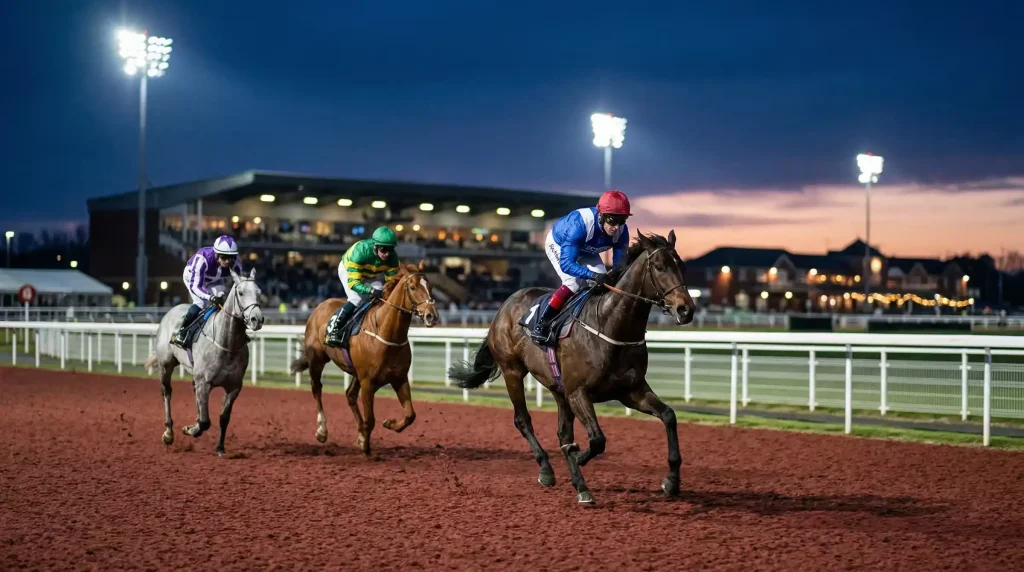
Southwell evening racing operates under a different set of rules from the daytime cards, and not just because the lights are on. The floodlit meetings — typically starting between 4pm and 5pm in winter and running until 8pm or later — attract a distinct profile of runner, a distinct betting market and a distinct set of challenges for anyone trying to find value. Treating an evening fixture at Southwell the same way you would treat an afternoon card is a reliable way to lose money slowly.
The course installed state-of-the-art LED floodlights in 2019, making it one of the best-equipped all-weather venues for night racing in Britain. With 79 fixtures confirmed for 2026, a significant portion of the calendar falls into the evening slot — particularly through the core all-weather months of October to April, when daylight is scarce and the Tapeta surface is in constant use. Understanding how these meetings differ from their daytime equivalents is not optional for regular Southwell bettors. It is foundational.
Fixture Frequency and Seasonal Spread
Evening fixtures at Southwell cluster in the winter half of the year. From late October through to March, midweek evening cards are a staple of the programme, often scheduled on Tuesdays, Wednesdays and Thursdays. The 2026 fixture list introduces a trial of 8pm finishes for all-weather meetings in the first nine weeks of the year, a change from earlier seasons when the final race could run as late as 8:30pm.
The UK fixture list for 2026 contains 1,458 programmed meetings nationally. Southwell’s 79 fixtures represent roughly 5.4% of the total — a disproportionately large share for a single venue, reflecting the course’s role as a workhorse of the all-weather programme. Many of those 79 dates carry evening start times, giving the venue one of the highest concentrations of floodlit racing in the country.
Saturday evening meetings, introduced more prominently in the 2026 schedule to replace the previous pattern of Friday night racing, bring a slightly different atmosphere. Weekend cards tend to draw larger fields and attract more recreational betting activity, which alters the market dynamics in ways covered below.
Field Sizes and Market Liquidity After Dark
Evening meetings at Southwell typically produce slightly smaller fields than afternoon fixtures at the same class level. This is partly logistical — transporting horses to an evening meeting requires a different schedule, and some trainers prefer not to run their charges under lights — and partly structural. Evening cards are often programmed as seven-race meetings with lower minimum values, which limits the pulling power for connections weighing up whether to make the journey.
Smaller fields have a direct effect on the betting market. With six or seven runners instead of nine or ten, the favourite’s implied probability rises and the each-way terms narrow — two places at quarter-odds rather than three. Market liquidity on betting exchanges also tends to be thinner in evening meetings, particularly for the lower-class handicaps that make up the bulk of the card. This thinner liquidity means prices can be more volatile in the final minutes before the off, creating opportunities for patient bettors who are comfortable placing bets closer to the start.
The flipside is that less competitive fields can produce more predictable results. When a race has only six runners and one of them has significantly better form than the rest, the market gets it right more often. The trick is to identify when the market is underpricing certainty in small fields — which is less common — versus when it is overpricing the favourite due to a lack of credible alternatives.
Trainer Patterns in Evening Fixtures
Not all trainers approach evening racing equally. Yards located within easy reach of Southwell — the East Midlands, South Yorkshire and Lincolnshire in particular — have an inherent logistical advantage for evening fixtures. A horse can leave the yard mid-afternoon, arrive at the course with time to settle and race under lights without disrupting the next morning’s training routine. For more distant operations, the travel equation is less favourable, and many choose to skip midweek evenings altogether.
This geographical filter narrows the pool of regular evening-meeting trainers. Locally based yards with a string of all-weather horses tend to dominate the entries, and their runners often carry better course knowledge than visitors from farther afield. When a Newmarket or Lambourn trainer does send a runner to a Southwell Tuesday evening, it is worth asking why — the answer is usually that the horse needs a specific race at a specific class level, which can indicate either a genuine chance or a conditioning run with no winning intention.
Tracking trainer strike rates specifically in evening fixtures, rather than across all Southwell appearances, can reveal meaningful differences. Some yards perform significantly better after dark, either because their horses are accustomed to the routine or because they target evening meetings strategically. The names change from season to season, but the pattern holds: local specialists with high run frequency outperform occasional visitors in evening fixtures by a measurable margin.
Jockey availability follows a similar logic. The busiest flat jockeys often ride at afternoon meetings at higher-profile venues and are not available for Southwell evenings. This creates opportunities for apprentice and conditional riders, whose claims — weight allowances of 3lb, 5lb or 7lb — can be significant in handicaps. An evening card at Southwell may feature several horses carrying a meaningful weight reduction thanks to a claiming rider, and those claims can shift the competitive balance in a race more than the form book alone suggests.
Practical Tips: Timing Bets Around Evening Meetings
The thinner markets at evening meetings create a specific tactical opportunity around bet timing. Morning prices for Southwell evening cards are set by bookmakers with less information than they have for high-profile afternoon fixtures. Overnight declarations can shift the picture significantly — a notable jockey booking, a first-time visor or a significant trainer switch can all appear in the morning and not be fully reflected in prices until closer to post time.
For bettors who do their homework before the markets sharpen, there is value in early pricing on evening cards. The window between declarations (usually 10am the day before) and the market settling (typically the last 30 minutes before the first race) is wider and less efficient than for afternoon meetings. In practice, this means checking the declared runners and riders as soon as they appear, forming a preliminary shortlist and monitoring price movement through the day.
One structural point worth noting: evening meetings at Southwell tend to produce a higher proportion of short-priced winners in the opening races on the card, when the form is most transparent and the market has had the most time to settle. Later on the card, as conditions evolve and the market becomes less certain, longer-priced winners appear more frequently. If you are the type of bettor who prefers selectivity over volume, concentrating on the first three races of an evening card — where the form is clearest and the markets most reliable — is a disciplined starting point.
Evening racing at Southwell is not a lesser product than the daytime programme. It is a different product, with its own rhythms and its own value pockets. Approach it on its own terms and it rewards the effort.