
Southwell Draw Bias: What the Post-2021 Numbers Show
Best Horse Racing Betting Sites – Bet on Horse Racing in 2026
Loading...
Southwell draw bias is one of the most debated — and most misunderstood — topics among all-weather punters. The problem is straightforward: much of the analysis still floating around the internet is based on the old Fibresand surface, which was ripped up and replaced with Tapeta on 7 December 2021. That date matters. Anything built on pre-2021 stall data belongs in a museum, not a racecard analysis.
Fibresand was deep, slow and produced significant kickback. It created observable draw biases, particularly in sprints, where lower-numbered stalls near the rail were at a disadvantage because the quickest ground sat towards the centre of the track. Tapeta is an entirely different material — a blend of sand, wax and fibre engineered for consistent drainage and a more uniform racing surface. That engineering changes the draw conversation fundamentally.
What follows is a distance-by-distance breakdown of stall position performance at Southwell since the Tapeta installation, drawing on results from more than four full seasons of racing. The sample size is now large enough to separate signal from noise, though it is worth remembering that no track bias is permanent — maintenance schedules, weather patterns and field-size trends all introduce variance across individual meetings.
According to Tapeta Footings, a key design objective of their surface is the elimination of draw bias through uniform drainage and consistent surface composition. Whether that ambition holds up at Southwell is exactly what the numbers can tell us.
5-Furlong Sprints: Centre vs Rail
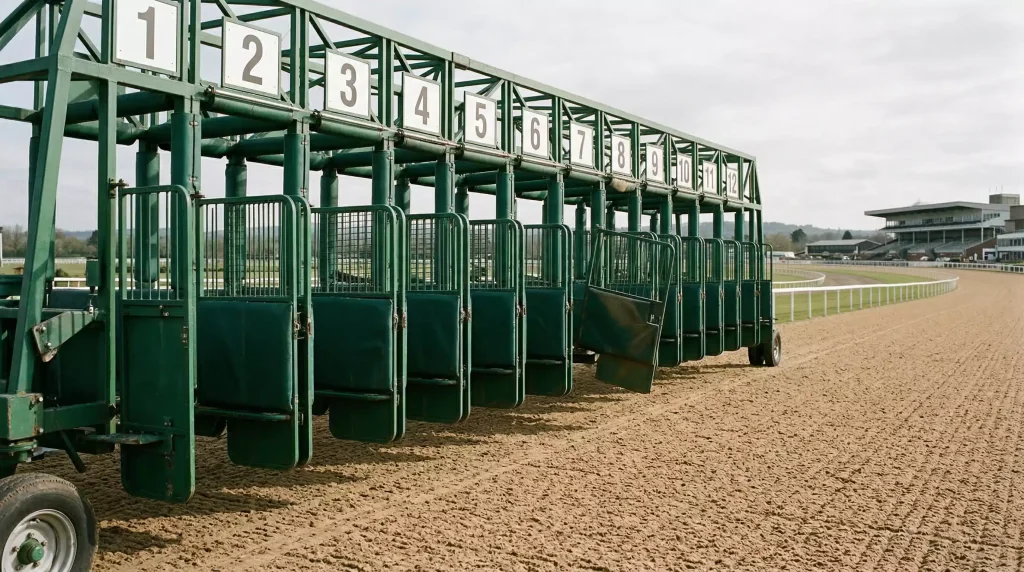
The five-furlong sprint at Southwell is run on a straight chute that feeds into the home straight, making it the only distance at the course where the stalls are positioned in a line perpendicular to the finish rather than on a bend. That layout creates the clearest potential for draw bias, because horses in different stalls run on slightly different strips of ground for the entire race.
On the old Fibresand, low draws were widely avoided. The rail was considered dead ground, and middle-to-high stalls won disproportionately. The question is whether Tapeta has levelled that out.
Post-2021 data shows a markedly more even distribution than Fibresand ever produced. Stalls 1 through 3 no longer carry the penalty they once did — win rates from the lowest three stalls are broadly in line with expectation when adjusted for field size. That said, there is a mild cluster of outperformance in stalls 4 through 7 in fields of ten or more runners, where horses drawn towards the centre of the track appear to get marginally cleaner runs. The effect is small — roughly two to three percentage points above expected strike rate — and it does not survive as a standalone profitable angle once starting prices are factored in.
High draws, stalls 10 and above, show no significant advantage or disadvantage. In small fields of seven or fewer, the draw at five furlongs is essentially neutral. The old rule of thumb — avoid the rail — no longer applies on Tapeta, though a slight centre preference persists in larger fields.
6f and 7f: How the Bend Changes Things
At six and seven furlongs, the start moves onto the oval and runners must negotiate at least one turn before entering the home straight. The bend is tight and left-handed, which introduces a different dynamic: the horse drawn lowest is closest to the rail and has less ground to cover, but must hold position through the curve without being squeezed.
On Fibresand, this produced a genuine low-draw advantage at six furlongs, because the kickback from the deep surface punished anything that sat behind the pace. Horses drawn inside could press forward, save ground on the bend and avoid the worst of the sand spray. On Tapeta, with its dramatically reduced kickback, that inside-rail benefit has largely evaporated.
The six-furlong data since December 2021 shows no statistically significant stall bias in either direction. Stalls 1 through 4 win at almost exactly the rate you would expect from their starting price implied probabilities. The same is true for stalls 8 and above. There is no cluster, no pattern, and no profitable system based purely on stall number.
Seven furlongs tells a similar story, with one caveat. In fields of twelve or more — which occur rarely but do happen in competitive handicaps — horses drawn widest have a slight tendency to underperform. This is likely a function of the wider ground lost on the bend rather than a surface issue. The effect is too inconsistent and the sample too thin to build a serious angle around, but it is worth noting for those who weight draw data heavily in handicap analysis. For standard fields of eight to eleven, the draw at seven furlongs is neutral on Tapeta.
1 Mile and Beyond: Draw Becomes Less Relevant
Once the trip extends to a mile and beyond, the conversation about draw bias at Southwell becomes almost academic. Horses start on the back straight, have time to settle into position before the first bend, and the race unfolds over enough ground that early positional advantages wash out. This was true on Fibresand and it remains true on Tapeta.
At one mile, no stall group — low, middle or high — shows a meaningful deviation from expected win rates. The same applies at one mile two furlongs, the standard round-course trip, and at the extended distances used for staying races up to two miles on the flat.
If anything, longer races at Southwell shift the relevant question away from draw and towards running style. The pace of the race and where a horse sits in the early stages matters far more than which stall it left from. A prominent racer drawn 12 in a mile handicap is at no disadvantage compared to one drawn 2 — both will have ample time to find their preferred position before the home turn.
For bettors, this means that any racecard comment emphasising draw advantage at a mile or further at Southwell should be treated with scepticism. The data does not support it. Focus instead on course and distance form, the likely pace scenario and whether the runner is suited to a left-handed track with a short home straight — all of which are far stronger predictors than stall number at these distances.
How Tapeta’s Drainage Reduces Positional Advantage
The near-absence of draw bias at Southwell post-2021 is not accidental. It is a product of how Tapeta is built. The surface sits on a drainage layer designed to move water vertically through the material, preventing pooling and ensuring that the ground near the rail rides the same as the ground in the centre or towards the outside. Research cited by the surface manufacturer indicates that horses working on Tapeta experience approximately 50% less concussive impact on their limbs compared to other surfaces — a finding drawn from the US Jockey Club’s Equine Injury Database covering 2009 to 2016.
That consistency has a direct consequence for draw analysis. On Fibresand — and on poorly maintained synthetic surfaces more generally — water would sometimes collect near the inside rail, creating a strip of false ground that penalised low-drawn runners. On Tapeta with functioning drainage, the inside strip does not deteriorate at the same rate. Maintenance crews at Southwell harrow the surface regularly, and the 2024 resurfacing following the 2023 floods means the current Tapeta is effectively in its early life, when uniformity is at its highest.
None of this means draw bias can never emerge at Southwell. A prolonged spell of freezing weather, a localised drainage failure or an unusually heavy card could temporarily skew conditions. Bettors should monitor going reports and jockey feedback at individual meetings rather than relying on blanket rules. But as a starting position, the data from four-plus years on Tapeta is clear: stall position at Southwell is no longer the factor it was, and at most distances it is not a factor at all.
The practical takeaway is simple. If your selection process for Southwell starts with the draw, you are solving the wrong problem. Start with form, pace and class — and let the draw be a tiebreaker, not a filter.