
Responsible Gambling at Southwell: Keeping Betting in Perspective
Best Horse Racing Betting Sites – Bet on Horse Racing in 2026
Loading...
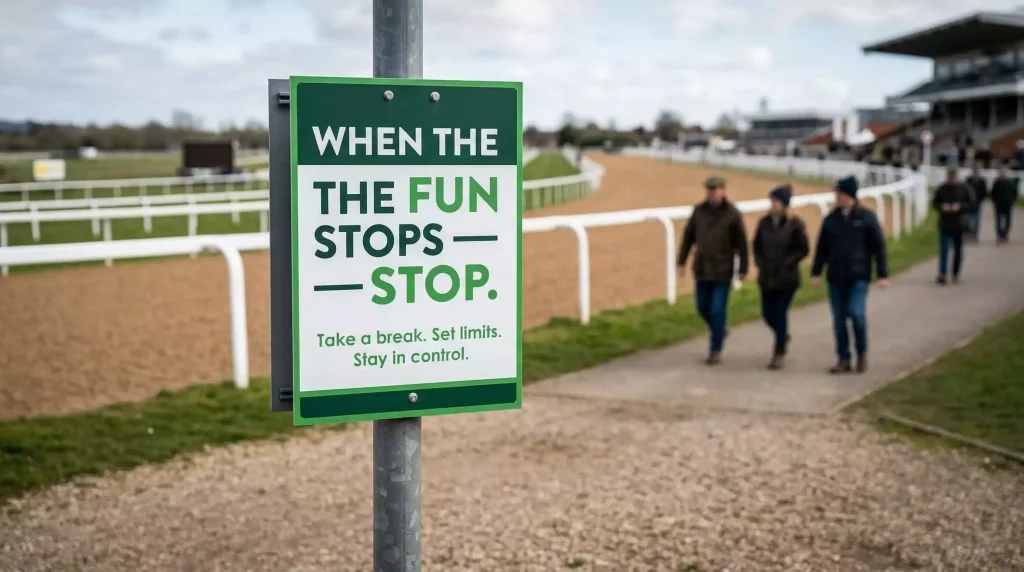
Responsible gambling in horse racing is not a footnote at the bottom of a terms-and-conditions page. It is a practical concern that affects real people, including the ones reading this at Southwell or from home on a Tuesday evening. This guide covers the tools available to manage your betting, the support services that exist if things go wrong and the broader context in which those tools operate. It is written without moralising and without pretending that everyone who bets on horses has a problem. Most do not. But some do, and the line between enjoyment and difficulty is not always obvious until you have already crossed it.
Southwell stages 79 fixtures a year — one of the highest volumes of any British racecourse. That frequency is a positive for bettors who want regular opportunities, but it also creates a specific risk: the temptation to bet on every meeting simply because it exists. Having a clear framework for how you engage with the sport is the difference between betting as a considered activity and betting as a reflex.
The Scale of the Issue: Why Licensed Operators Matter
The relationship between gambling regulation and consumer protection has become one of the most contentious topics in British racing. BHA Director of Racing Richard Wayman stated plainly that he has “no doubt” the decline in betting turnover is “headed by the impact of affordability checks and the extent to which they have resulted in people either stopping betting or placing their bets with unlicensed operators.”
The scale of that migration is striking. The International Federation of Horseracing Authorities reported a 522% increase in unique UK visitors to 22 unlicensed betting sites between August 2021 and September 2024, compared with just a 49% rise at licensed platforms over the same period. Unlicensed operators sit outside the regulatory framework — they do not conduct financial vulnerability checks, they do not contribute to responsible gambling programmes and they offer no consumer protection if something goes wrong.
This matters for every punter, not just those at risk. The argument for using licensed, Gambling Commission-regulated operators is not about whether the checks are perfectly calibrated — reasonable people disagree on that. It is about ensuring that the money you bet with is processed by companies that are legally accountable, that your funds are protected and that you have access to the self-management tools described below. None of those safeguards exist on unlicensed platforms.
Tools Available: Deposit Limits, Reality Checks and Time-Outs
Every licensed betting operator in Great Britain is required to offer a suite of responsible gambling tools. These are not hidden or difficult to find — they sit in the account settings of your bookmaker app or website, typically under a heading like “Safer Gambling” or “Responsible Gambling.”
Deposit limits allow you to cap the amount of money you can add to your betting account within a given period — daily, weekly or monthly. Once you hit the limit, no further deposits are accepted until the period resets. You can lower a limit at any time and it takes effect immediately. Raising a limit, by contrast, involves a cooling-off period — usually 24 to 72 hours — to prevent impulsive increases during a losing run.
Reality checks are timed notifications that appear while you are betting, reminding you how long you have been logged in and how much you have wagered. They can be set at intervals — every 30 minutes, every hour, every two hours — and they serve as a simple pattern interrupt. A reality check does not stop you from betting, but it forces a moment of conscious awareness that can break the autopilot loop of placing bet after bet.
Time-outs are temporary breaks from your account, ranging from 24 hours to six weeks depending on the operator. During a time-out, you cannot log in, place bets or deposit funds. Unlike self-exclusion, a time-out is not permanent and does not require a formal reinstatement process. It is a useful tool if you recognise that a specific period — a stressful week at work, a run of losses, a major festival where the temptation to overtrade is high — warrants a deliberate step back.
Self-Exclusion: GamStop and On-Course Options
For situations that go beyond a temporary break, GamStop is the national self-exclusion scheme for online gambling. Registering with GamStop blocks you from all licensed online gambling operators in Great Britain for a minimum period of six months, with options for one year or five years. The process is free, and once activated, operators are legally required to close your accounts and prevent you from opening new ones.
GamStop covers online betting only. If you attend Southwell in person and want to self-exclude from on-course betting, the racecourse and individual bookmakers offer their own schemes. These are less centralised and require separate requests to each operator, which makes them more cumbersome but still available. The Southwell racecourse team can provide information about on-course self-exclusion options if you ask at the customer services desk.
One important note: self-exclusion is not easily reversed. If you sign up for a five-year GamStop exclusion and change your mind after six months, you cannot simply opt back in. The commitment is genuine, and it should be treated as a serious decision rather than a casual one. For many people, that permanence is the point — it removes the option to change your mind in a weak moment, which is precisely when the decision to return would be most dangerous.
Where to Get Support
The concentration of revenue among a small number of bettors is more extreme than most people realise. Research from the National Centre for Social Research found that the top 1% of horse racing bettors — approximately 60,000 individuals — generate 52% of all betting revenue. That concentration means a relatively small group of people are carrying a disproportionate share of the financial risk, and they are the ones most likely to need support if their betting becomes harmful.
GambleAware operates the National Gambling Helpline, which is free, confidential and available by phone or live chat. The service is staffed by trained advisors who can discuss your situation, help you assess whether your gambling is causing harm and connect you with local support services if needed. GamCare, the charity behind the helpline, also runs face-to-face and online counselling programmes.
Gordon Moody is a specialist residential treatment provider for people with severe gambling problems. Their programmes — which include residential stays and online therapeutic courses — are designed for people whose gambling has reached a point where outpatient support is insufficient. The service is free and referrals can be made through GamCare or directly.
For horse racing specifically, Racing Welfare provides confidential support to anyone working in or connected to the racing industry, including people who bet on the sport. They understand the particular rhythms and pressures of racing — the year-round fixture list, the emotional highs and lows, the proximity to betting markets at work — in a way that generic gambling support services may not.
None of these services require you to have reached crisis point before making contact. If you are wondering whether you need help, the act of wondering is itself a reason to reach out. The tools exist. The question is whether you use them before they become urgent rather than after.