
Front-Runners at Southwell: Separating Myth From Tapeta Data
Best Horse Racing Betting Sites – Bet on Horse Racing in 2026
Loading...
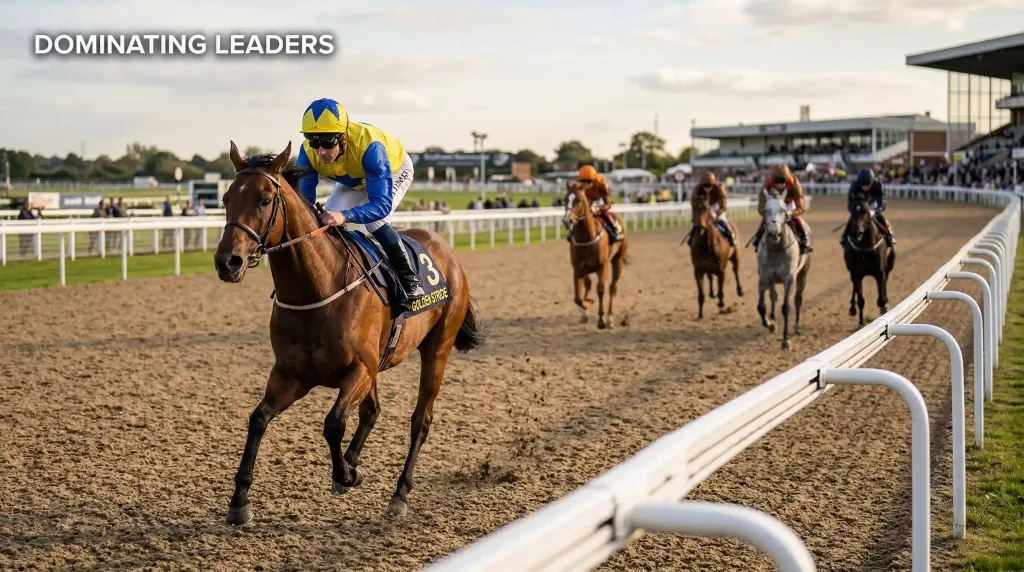
Front-runners at Southwell carry a reputation built in an era that no longer exists. On the old Fibresand surface, horses that led from the front enjoyed a structural advantage so pronounced it bordered on automatic — the deep sand, the heavy kickback and the energy cost of racing behind a wall of flying grit made hold-up tactics a losing proposition at most distances. That reputation has stuck. Walk into any betting shop in the country and mention Southwell, and someone will tell you to back the horse that leads. The question is whether the data from four years of Tapeta racing supports that advice, or whether it is a relic from a surface that was torn up in 2021.
The answer, as is usually the case in racing, is somewhere between yes and no. Front-runners still perform well at Southwell. They do not dominate the way they did on Fibresand. The edge has narrowed, the circumstances in which it applies have become more specific and the blanket rule of always backing the leader has become unprofitable at starting prices. What remains is a more nuanced positional advantage that depends on distance, field size and the quality of opposition.
Win Rates by Running Style and Distance
Classifying running styles is imprecise — a horse labelled as a front-runner in one race might sit second or third in another — but the broad patterns are clear enough to be useful. Since the Tapeta installation, horses that led or raced within a length of the leader at the first timing point have won at a rate above expected at five and six furlongs, roughly at expected at seven furlongs and one mile, and slightly below expected at one mile two furlongs and beyond.
At five furlongs, the straight-course layout amplifies the front-runner advantage. There are no bends to navigate, no tactical waiting and no point in the race where a leader can be swallowed by a closing group. The BHA Racing Report recorded average flat field sizes of 8.90 in 2025 — and in sprint fields of that size on the straight course, the leaders have enough room to establish position without being crowded and enough distance from the finish to hold on.
At six furlongs, the leader’s edge persists but is smaller. The start is on the turn, which means the field bunches through the bend and sorts itself out in the home straight. A front-runner that can secure the rail and maintain momentum through the curve holds an advantage, but a horse racing in second or third is close enough to challenge without losing excessive ground.
At a mile and beyond, the front-runner advantage largely disappears. The longer trip gives trailing horses more time and space to close, the pace tends to be steadier through the early stages and the three-furlong home straight is long enough for a well-timed challenge from behind. Horses that lead at these distances can still win — especially in small fields where the pace pressure is low — but they do not win at a rate that justifies systematic support.
How Tapeta Compares to Fibresand for Front-Runners
The structural reason for the diminished front-runner advantage is the surface itself. Fibresand’s deep, demanding composition and extreme kickback created a physical barrier for any horse that tried to race behind the leaders. Sand sprayed directly into the face of a trailing horse, causing discomfort and costing energy. Horses that avoided that spray — by leading — had an advantage that was partly tactical and partly physiological.
Tapeta produces dramatically less kickback. Research from the surface manufacturer indicates that horses working on Tapeta experience approximately 50% less concussive impact on their limbs compared to other surfaces, and the reduced material displacement means that trailing horses are no longer running through a curtain of debris. On a surface where kickback is minimal, the cost of sitting behind the pace drops, and hold-up tactics become viable in a way they never were on Fibresand.
The other factor is drainage uniformity. On Fibresand, the inside rail often rode slower than the centre of the track, which penalised hold-up horses who saved ground by racing on the rail while the leaders ran down the middle. On Tapeta, the rail rides at a similar speed to the rest of the surface, removing that secondary disadvantage. A horse that tracks the leaders on the rail and kicks at the two-furlong pole is operating on equal footing — literally — to the horse that made the running on the outside.
Field Size and Pace Pressure
The number of runners changes the front-runner equation more than most bettors appreciate. In small fields — six or fewer runners — a front-runner faces minimal pace pressure. It can dictate the tempo, conserve energy through the middle stages and kick for home without being challenged until late. In these races, the leader often wins even over distances where front-running is not normally dominant, simply because nobody is pushing it hard enough to break its rhythm.
In larger fields — ten or more runners — the dynamic reverses. Multiple horses want to lead or race prominently, which creates pace pressure from the start. The front-runner is forced to go faster than it would like, burns energy in the first half of the race and becomes vulnerable to closers in the final furlong. Large-field Southwell handicaps at a mile or further are among the worst environments for a front-runner, because the combination of pace pressure, competitive fields and a short home straight conspires against the leader.
The sweet spot for front-runner bets at Southwell is a field of seven to nine runners at five or six furlongs, where the horse in question has a clear speed advantage over the rest of the field and is unlikely to be challenged for the lead early. In that scenario, the Tapeta surface, the straight or near-straight course and the moderate field size all work in the leader’s favour. Outside that window, the front-runner angle becomes progressively less reliable.
Practical Angles for Pace Handicappers
Pace handicapping at Southwell is not about blindly backing leaders. It is about reading the likely race shape before the off and deciding how that shape affects each horse’s chance. The process starts with identifying the probable front-runner — usually the horse with the fastest early sectional times in recent starts — and then assessing whether it will be challenged for the lead.
If one horse is the clear speed in the race and no other runner has shown early pace in recent form, the front-runner is in a favourable position. The market may underestimate this advantage, particularly in handicaps where the favourite is a hold-up type with a higher rating. A lower-rated front-runner that gets an easy lead can outrun its odds by dictating a slow or moderate tempo and sprinting for home in the final two furlongs.
Conversely, if two or three confirmed front-runners are in the same race, the pace is likely to be suicidal — and the horse to back is the one that sits just behind the speed. At Southwell, where the home straight is only three furlongs long, the horse in third or fourth position at the turn has the ideal combination of a ground-saving run and enough runway to close. Identifying these pace collapses before they happen — by checking each runner’s recent running position at the first call — is one of the most reliable angles available on the all-weather circuit.
The front-runner myth at Southwell is not entirely mythical. It is a real advantage in specific circumstances: short distances, moderate fields, unopposed leads. Outside those conditions, the Tapeta surface has levelled the playing field between leaders and closers to a degree that the old Fibresand never did. The punters who adjust for that shift have an edge over those still living in 2020.