
How to Bet at Southwell Racecourse: A First-Timer's Guide
Best Horse Racing Betting Sites – Bet on Horse Racing in 2026
Loading...
If you have never placed a bet at a racecourse, how to bet at Southwell racecourse is a simpler question than you might expect — but there are enough moving parts to trip up the unprepared. The mechanics of getting money on a horse are straightforward. The choices you face in how and where to place that bet are what separate a decent experience from a frustrating one.
Southwell is one of the busiest racecourses in Britain, staging 79 fixtures in 2026 across both the all-weather Tapeta flat track and the National Hunt turf course. That volume means it is an accessible venue for newcomers — there are meetings most weeks, admission is affordable and the atmosphere is relaxed compared to the sharper dress codes and higher prices of major festival venues. Horse racing remains the UK’s second most-attended sport, with 5,031,640 people visiting a British racecourse in 2025 — the first time the figure had topped five million since before the pandemic. Southwell accounts for a healthy share of that footfall.
On-Course Betting: Bookmakers and the Tote
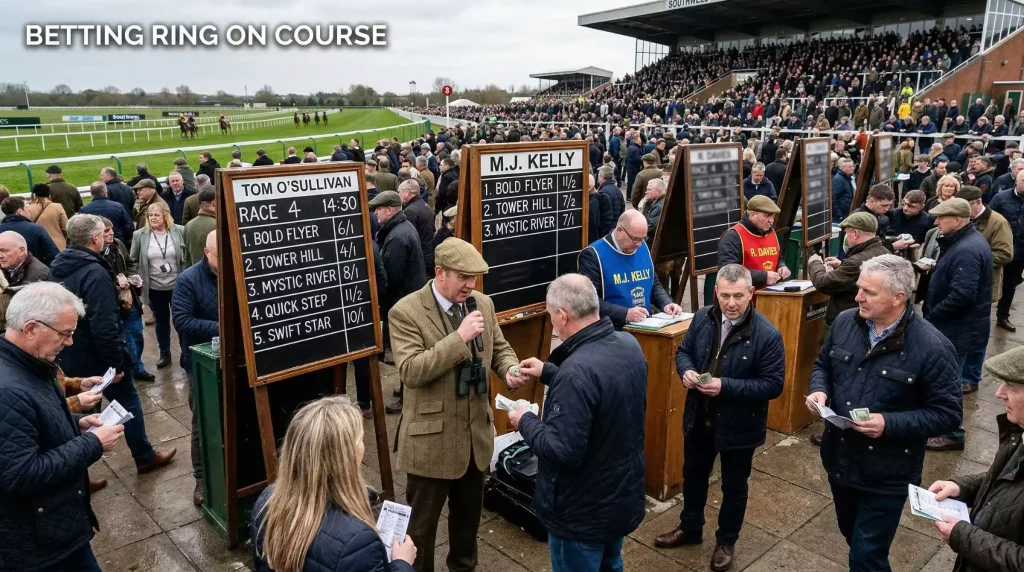
When you walk into the Southwell grandstand enclosure, you will find two distinct ways to place a bet on the course itself: the ring bookmakers and the Tote.
The ring bookmakers stand in a row in front of the grandstand, each displaying their own set of odds on a board or digital screen. You approach a bookmaker, state the horse you want to back, the amount you want to bet and the type of bet. They give you a physical ticket as a receipt. If your horse wins, you return to the same bookmaker to collect your payout. The odds you receive are the odds displayed at the moment you place the bet — they are fixed, which means if the price shortens after you bet, you keep the higher price. The flip side is that if the price drifts, you are stuck with your earlier, lower odds.
The key practical point: bring cash. Ring bookmakers at Southwell accept cash payments, and while some now take card, it is not universal. There are no cash machines on-site at the racecourse, so you need to arrive with whatever you intend to bet. This is worth knowing before you get there — arriving at Southwell with only a bank card and finding the bookmaker you want to use is cash-only is an avoidable annoyance.
The Tote operates differently. It is a pool betting system — similar in principle to the lottery — where all bets on a race go into a pool, the operator takes a percentage, and the remainder is divided among the winning ticket holders. Tote payouts are calculated after the race finishes, which means you do not know your exact return at the time of placing the bet. The Tote can sometimes return more than starting price, particularly on longer-priced winners in races where heavy money has gone on the favourite. It can also return less. The Tote accepts both cash and card at Southwell.
Betting via Apps at the Track
Southwell offers free Wi-Fi across the racecourse, which opens up the option of betting through your usual online bookmaker while you are on-course. For many racegoers, particularly those who already have funded accounts with licensed operators, this is the most convenient route. You get access to the full range of bet types, Best Odds Guaranteed promotions and in-play markets without having to queue at a bookmaker or the Tote.
The advantage of app betting at the track is price comparison. While you are standing in the grandstand watching horses in the parade ring, you can check three or four bookmaker apps to find the best available odds on your selection. The ring bookmaker in front of you might be offering 5/1, while your app shows 6/1 elsewhere. Over the course of a full day’s racing — six or seven races on a typical Southwell card — those fractions add up.
The disadvantage is the experience. Part of the appeal of a day at the races is the interaction with bookmakers, the physical ticket, the walk to the rail to watch the finish. Betting through a screen while you are standing at a racecourse can feel oddly disconnected. There is no right answer here — it depends on whether you are there primarily to bet or primarily to enjoy the day. Most seasoned racegoers do both: app for the serious bets, ring bookmaker for the fun ones.
Understanding Odds Formats: Fractional, Decimal and SP
British horse racing traditionally uses fractional odds — 5/1, 9/2, 11/4 and so on. These tell you the profit you make relative to your stake. At 5/1, a one-pound bet returns five pounds of profit plus your one-pound stake, for a total of six pounds. At 9/2, a two-pound bet returns nine pounds profit plus your two-pound stake — eleven pounds total.
Decimal odds, used as the default on betting exchanges and by some bookmaker apps, express the same information differently. Decimal 6.0 is the same as fractional 5/1 — your total return per unit staked. Decimal odds are easier to calculate quickly: multiply your stake by the decimal number to get your total return. A five-pound bet at 6.0 returns thirty pounds. No mental gymnastics with numerators and denominators.
SP — Starting Price — is the official odds of a horse at the moment the race begins, determined by an independent assessor based on the prices available in the ring. If you bet at SP, your payout is calculated after the race at whatever the official starting price was. Some bettors prefer to take a price early if they think it will shorten; others prefer SP to avoid being stuck with a bad price if the horse drifts. At Southwell, where market movements can be significant on less liquid cards, taking an early price on a horse you believe in is generally preferable to leaving it to SP.
Common Bet Types Explained
The simplest bet is a win single: pick one horse, bet on it to win. If it finishes first, you collect; otherwise you lose your stake. This is where most newcomers should start, because it is the easiest to understand and the easiest to track.
An each-way bet is two bets in one: a win bet and a place bet on the same horse. If the horse wins, both parts pay out. If it finishes in a place position — typically first, second or third depending on field size — only the place part pays, at a fraction of the win odds. Each-way costs double the unit stake (a five-pound each-way bet costs ten pounds: five on the win, five on the place). It is a useful tool in competitive handicaps where you like a horse’s chance of finishing in the frame but are less confident about it winning outright.
Multiples — doubles, trebles and accumulators — involve combining two or more selections into a single bet. All selections must win for the bet to pay out. The returns are multiplied together, which creates large potential payouts but also dramatically increases the risk. A four-horse accumulator where each horse has a roughly 25% chance of winning has an overall probability of about 0.4%. These bets are popular but statistically brutal. If you enjoy them for entertainment, set a strict and small stake. If you are betting to make money, singles and each-way bets are a sounder foundation.
Betting at Southwell, whether on-course or through an app, does not require expertise — it requires clarity about what you are doing and why. Start with win singles, learn the mechanics, and add complexity only when the basics feel automatic.