
All-Weather Racing Calendar: How the UK Season Is Structured
 Available in US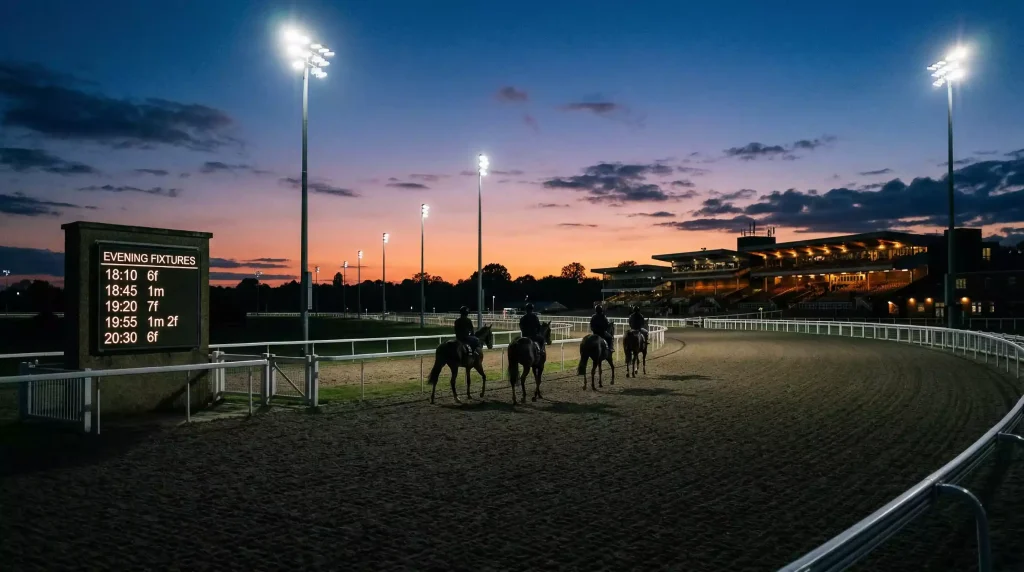
The all-weather racing calendar in the UK does not follow the same rhythm as turf racing, and punters who treat it as a secondary afterthought during the winter months are missing a year-round programme with its own logic, its own peaks and its own betting dynamics. Six tracks — Chelmsford City, Kempton Park, Lingfield Park, Newcastle, Southwell and Wolverhampton — stage flat racing on synthetic surfaces throughout the year, with the heaviest concentration of fixtures running from October through to April. Understanding how that calendar is structured, when the fixture density peaks and where the key dates fall is essential preparation for anyone who takes all-weather betting seriously.
The BHA fixture list for 2026 programmes 1,458 meetings nationally, a slight reduction from 1,460 in 2025 and 1,468 in 2024. All-weather fixtures account for a significant share of that total — comfortably over 200 meetings across the six venues — making the AW circuit one of the most active segments of British racing.
All-Weather Racing Calendar — More on this topic at southwell betting.
October to April: The Core AW Window
The all-weather season does not have a formal opening day in the way that the turf flat season begins at Doncaster in late March. Instead, it ramps up gradually through October as the turf programme winds down, reaching peak density by November and maintaining that level through to Good Friday in April, when the All-Weather Championships Finals Day provides a natural crescendo.
During this core window, all-weather meetings run almost every day of the week. A typical midwinter week might feature meetings at Southwell on Tuesday and Thursday evenings, Wolverhampton on Monday and Wednesday, Kempton or Lingfield on Friday, and Newcastle on Saturday. The total fixture count across the six venues regularly exceeds five or six meetings per week between November and March. The All-Weather Championships programme spans more than 200 fixtures across these months, incorporating Fast Track Qualifiers, competitive handicaps and a full range of novice and maiden events that give younger horses their first experience of synthetic-surface racing.
For bettors, the core window offers the highest opportunity density: more races, more runners, more data accumulating week after week. The challenge is volume management. Betting on every all-weather meeting is neither practical nor sensible. The disciplined approach is to identify two or three venues where you have the strongest form knowledge — Southwell, for instance, if you have been following the course closely — and concentrate your activity there, using the other venues primarily as cross-reference points when horses move between tracks.
Summer AW Fixtures: Why They Still Run
All-weather racing does not stop when the turf season begins. Through the summer months — May to September — the six AW venues continue to stage flat meetings, though at a reduced frequency. The rationale is partly commercial and partly equine: some horses are better suited to synthetic surfaces than turf and would have no racing opportunities during summer if the AW programme shut down entirely.
Summer all-weather meetings tend to attract smaller fields and lighter betting activity than winter fixtures. Many trainers with dual-surface horses redirect their better animals to the turf, leaving the summer AW cards populated by horses that cannot handle grass or that are being kept ticking over between more targeted campaigns. The form from summer AW meetings is less reliable as a guide to winter performance, because the horse population is different and the competitive level is generally lower.
That said, summer AW fixtures offer specific opportunities. The reduced attention from both professional bettors and casual punters means markets can be softer, prices less sharp and the occasional mispricing more persistent. A horse winning a summer AW race at Southwell in July at 8/1 might have been 5/1 or shorter if the same race had run in January, simply because fewer people were watching and fewer pounds were being wagered. For the bettor with year-round form knowledge, summer AW is a quieter hunting ground with less competition.
Summer AW meetings also serve as development ground. Well-bred two-year-olds from major flat yards sometimes make their debuts at summer all-weather fixtures, using the consistent surface as a low-pressure introduction to racing before targeting turf in the autumn. These debutants can be difficult to price accurately — the market leans heavily on stable reputation and breeding page rather than actual racecourse evidence — which creates mispricing opportunities in both directions. A well-touted newcomer may start at 2/1 and lose to a more experienced rival; an unfancied one may quietly win at 12/1 because nobody was paying attention on a Wednesday afternoon in June.
Fixture Volume by Month and Day of Week
The distribution of AW fixtures is not uniform across the calendar. November, December, January and February carry the heaviest load — these are the months when turf racing is at its most limited, and the AW tracks pick up the slack. March sees a slight reduction as the turf flat season approaches, and April concentrates on the final stages of the All-Weather Championships before Finals Day.
Day-of-week patterns are equally important for betting planning. Midweek evening meetings — typically Tuesday through Thursday — are the bread and butter of the all-weather programme, particularly at Southwell and Wolverhampton. These cards run under floodlights from around 4pm to 8pm and tend to feature Class 5 and Class 6 handicaps with moderate field sizes. Saturday afternoon AW fixtures are less frequent but higher-profile, sometimes carrying Fast Track Qualifier status or enhanced prize money. Sunday cards exist but are more sporadic. The 2026 fixture list introduces a trial of 8pm finishes for AW meetings in the first nine weeks of the year, a change that may affect the timing of the final race on winter evening cards.
The national fixture list for 2026 also includes rider-restricted meetings during designated break periods — five days in mid-February, for instance — when only jockeys licensed in Britain who have not ridden above a certain threshold are eligible. These meetings tend to feature less experienced riders, which changes the betting dynamic: jockey form becomes less predictive, and trainer intent becomes relatively more important as a selection factor.
Planning Your Betting Around the Calendar
The practical value of understanding the AW calendar is in preparation. Knowing when the fixture density peaks allows you to plan your research time, your bankroll allocation and your betting frequency in advance rather than reacting to each meeting as it appears.
See also Betting Turnover in UK Racing.
During the core October-to-April window, schedule regular analysis sessions — one or two per week — to review recent Southwell results, update your personal form notes and identify runners of interest for the coming week. During the quieter summer months, reduce the frequency but maintain the database: the horses running in July will be back in November, and the form you recorded in summer becomes winter intelligence.
Key dates worth highlighting on any AW bettor’s calendar include the All-Weather Championships Fast Track Qualifiers at Southwell (usually two to four per season, announced in the autumn), Finals Day at Newcastle on Good Friday, New Year’s Day fixtures (traditionally busy cards with large fields) and the period immediately after the November flat break, when horses return from a rest period and the form book resets to some degree.
The all-weather calendar is not a lesser version of the turf calendar. It is a parallel programme with its own structure, its own rhythms and its own opportunities. The bettors who treat it as a distinct discipline — rather than as the racing equivalent of a holding pattern — are the ones best placed to profit from it.
