
Southwell Betting Odds: How Prices Form and Where to Find the Best
 Available in US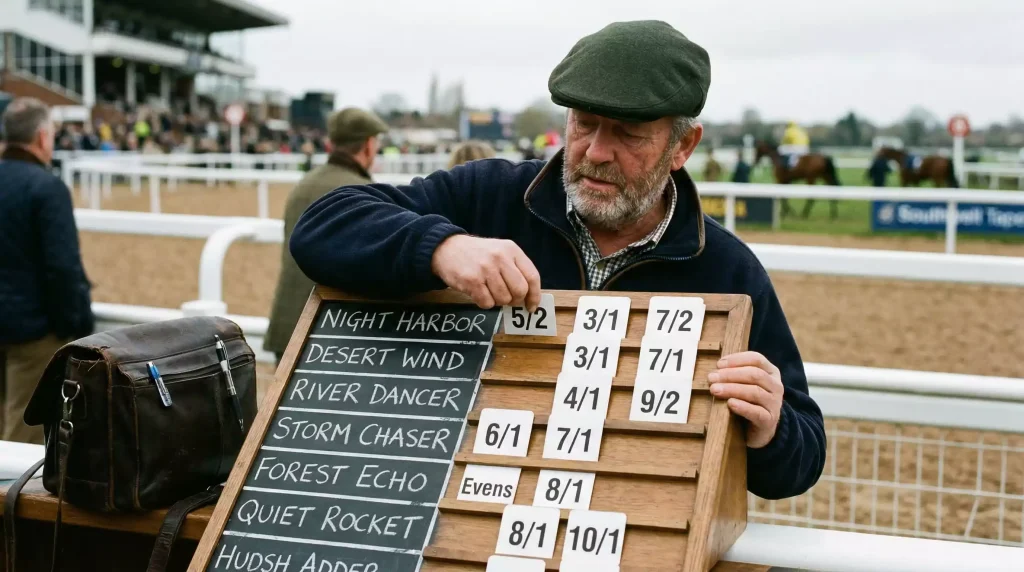
Southwell betting odds behave differently from the prices you see at Ascot or Cheltenham, and not just because the horses are less famous. The market dynamics at a Core all-weather venue — lower liquidity, fewer professional bettors, thinner exchange pools — create a pricing environment with its own quirks and its own opportunities. If you understand how odds form at Southwell, when they move and where the best prices tend to sit, you are working with a meaningful advantage over the majority of punters who simply take whatever number appears on their screen at post time.
The mechanics of odds are universal: they represent implied probability, adjusted for the bookmaker’s margin. What changes from venue to venue is how efficiently the market reaches the correct price. At a major meeting with deep pools and heavy professional interest, the market is sharp and mispricing is rare. At a Tuesday evening Southwell handicap with eight runners, the market is softer, the price formation is slower and the gaps between bookmakers are wider.
Southwell Betting Odds — More on this topic at southwell betting.
Starting Price vs Early Prices at Southwell
Starting Price — the official odds at the moment the race begins, determined by an independent assessor based on available ring prices — remains the default settlement method for many bets on British racing. At Southwell, SP can be generous or punitive depending on the race and the time of day.
For afternoon meetings with reasonable crowd numbers and several ring bookmakers in attendance, SP is a fair reflection of the market. For evening meetings under floodlights, where the betting ring is thinner and the crowd smaller, SP can be erratic. A horse that drifted from 3/1 to 5/1 in the final minutes before an evening race might return an SP of 9/2 — fine if you took 5/1 early, frustrating if you left it to SP and got less than you could have.
The general rule at Southwell is to take an early price when you have a strong opinion. Morning prices are set by bookmakers’ traders and often reflect overnight market money rather than the current state of the form book. If your analysis identifies a horse whose form has improved since its last run — a trainer switch, a return to a preferred distance, a drop in class — the morning price may not yet reflect that improvement. By post time, it often does. The bettor who acts on solid analysis at 9am has a structural advantage over the one who waits until 4:55pm.
Best Odds Guaranteed: How It Works on AW Racing
Best Odds Guaranteed is a bookmaker promotion that resolves the dilemma between early prices and SP. Under BOG terms, if you take a price in the morning and the SP is higher, you get paid at the higher price. If the SP is lower, you keep your original price. It is a free option — the bookmaker absorbs the risk of the price moving against you — and it is available from most major licensed operators on UK horse racing, including all-weather meetings at Southwell.
BOG removes much of the timing anxiety from betting at Southwell. If a horse you fancy is 7/1 in the morning, you can take that price knowing that if it drifts to 9/1 by post time, your bet will be settled at 9/1. In practice, this means there is almost no reason to wait for SP at Southwell when BOG is available. The only scenario where SP might outperform is if the horse shortens dramatically — say from 7/1 to 3/1 — in which case BOG pays at your original 7/1, which is significantly better than the SP of 3/1. Either way, you win.
Not all bookmakers offer BOG on every race. Some restrict it to UK and Irish racing only, some exclude races before a certain time of day, and some cap the maximum BOG payout. Check the terms of your preferred operator before assuming the promotion applies to every Southwell card.
Exchange Odds and Liquidity in Core Fixtures
Betting exchanges — where punters bet against each other rather than against a bookmaker — offer a different pricing structure. There is no built-in bookmaker margin; instead, the exchange takes a commission on winning bets, typically 2-5%. The result is that exchange odds are frequently better than bookmaker odds, sometimes significantly so.
At Southwell, the limitation is liquidity. Exchange pools are deepest at Premier meetings like Royal Ascot and the Cheltenham Festival, where millions of pounds are matched on individual races. At a Core all-weather fixture, the pool is a fraction of that. Average betting turnover per race at Core fixtures fell by 8.1% year-on-year in 2025 according to the BHA, which compounds the liquidity issue. In a Southwell Tuesday evening handicap, you might find only a few hundred pounds available at the price you want on the exchange, which limits the size of bet you can place without moving the market.
The practical approach is to use exchanges selectively at Southwell. For the feature race of the card — the one with the biggest field and the most media attention — exchange liquidity is usually adequate for moderate-sized bets. For the final race on a midweek evening card, it may not be. In those thinner races, traditional bookmaker odds with BOG will often deliver a better effective price than an exchange where the available volume is negligible.
Market Movers: What Steam and Drifts Tell You
A horse whose price shortens significantly — known as steaming — is attracting money. A horse whose price lengthens is drifting. Both movements carry information, but neither is infallible.
At Southwell, market moves tend to be more meaningful on afternoon cards than on evening cards, because afternoon meetings attract more informed money. A horse that shortens from 6/1 to 7/2 on a Saturday afternoon at Southwell is usually attracting bets from people who have a reason to back it — stable confidence, a significant jockey booking or private information about the horse’s wellbeing. On a Tuesday evening card, the same move might reflect a single large bet from someone following a tip rather than genuine inside knowledge.
See also Live Streaming Southwell Races.
Drifts are trickier. A horse that was expected to be popular but fails to attract money might be drifting because the connections have expressed doubt, because a rival looks stronger on the day, or simply because casual bettors have found something they like better. At Southwell, where the overall betting volumes are lower, a drift can happen for no structural reason at all — the market is thin enough that the absence of a few expected bets is enough to push a price out.
The HBLB annual report notes that average turnover per race has fallen by roughly 19% since 2021/22. In an environment of declining volume, market moves carry proportionally more noise. A 20% shortening in price at a Cheltenham novice hurdle — where millions are matched — is a strong signal. The same percentage move at a Southwell Class 6 handicap — where a few thousand pounds constitute the entire market — is weaker evidence. Weight your interpretation of market movers to the depth of the market, not just the direction of the price.
