
Reading a Racecard for Southwell: Everything on the Page, Decoded
 Available in US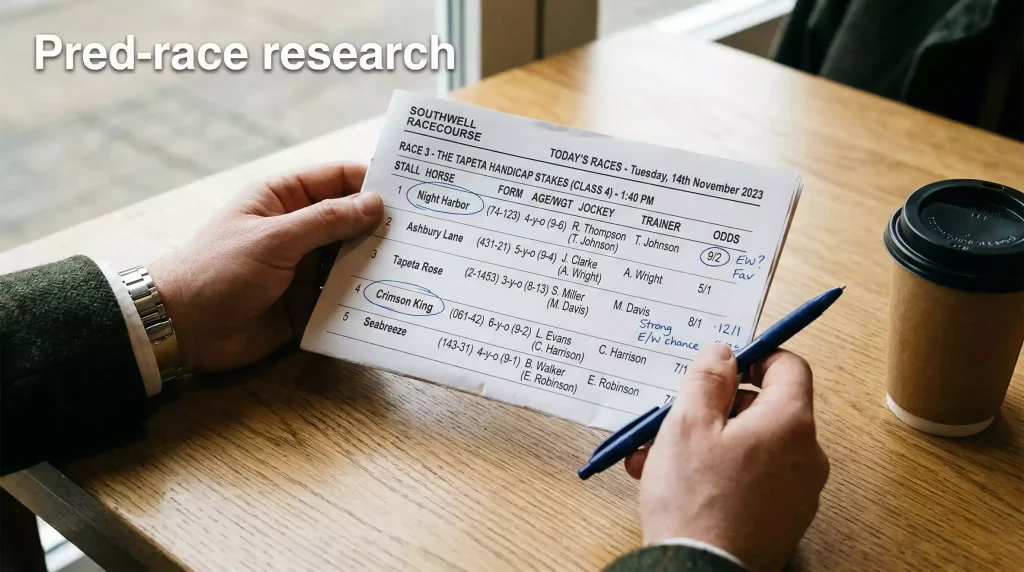
A Southwell racecard contains everything you need to make an informed bet — the problem is that it also contains a dense layer of shorthand, abbreviations and codes that mean nothing if you have not been taught to read them. The numbers next to each horse’s name are not decoration. They are a compressed record of recent performance, and once you can decode them, you are looking at raw material that no tipster summary can fully replace.
This guide works through each element of a standard racecard as you would encounter it for a Southwell meeting, whether on a printed card bought at the course or on a digital racecard from an online provider. The specifics are anchored to Southwell because certain codes — particularly those relating to the all-weather surface and course-and-distance form — carry different weight here than they do at turf venues. Southwell hosts 79 fixtures in 2026, so you will have plenty of opportunities to practice.
Reading a Racecard for Southwell — More on this topic at southwell betting.
Form Figures: What the Numbers and Letters Mean
The string of numbers and characters to the left of each horse’s name is its recent form, read from left to right in chronological order with the most recent run on the far right. A sequence like 3214-51 tells you that the horse finished third, second, first, fourth, then had a break (indicated by the dash), and in its last two runs finished fifth and first.
The numbers represent finishing positions: 1 is a win, 2 is second, and so on up to 9. A zero means the horse finished tenth or worse. Letters carry specific meanings: F indicates a fall, U means unseated rider, P is pulled up, R is refused, B is brought down, S is slipped up and O means the horse ran out. On all-weather cards at Southwell, falls are rare because flat racing does not involve obstacles — but you will see P occasionally in races where a horse was clearly struggling and the jockey decided to ease it rather than push for a minor placing.
The dash in the form string indicates a break between seasons or a gap of sufficient length that the compiler considers it worth noting. For Southwell regulars, the absence of a dash is often more telling than its presence — a string like 11232 with no break suggests a horse in regular, consistent work, which on the all-weather typically signals a trainer with a clear plan for the animal.
Course-and-distance form is usually flagged with the letters C, D or CD next to the horse’s name. C means it has won at this course; D means it has won at this distance; CD means both. At Southwell, the CD flag is a strong positive indicator — but only if the form was recorded on Tapeta. The racecard will not distinguish between a win on the old Fibresand and a win on the current surface. Any CD form dated before December 2021 should be treated as belonging to a different course entirely.
Weight, OR and Equipment Codes
Each horse in a handicap carries a weight determined by its Official Rating, abbreviated as OR on the racecard. The OR is a number assigned by the BHA’s handicapping team that represents the horse’s assessed ability. Higher numbers mean more weight. The weight itself is shown in stones and pounds — for example, 9-7 means nine stone seven pounds.
In non-handicap races (maidens, novices, conditions events), weight is determined by age and sex allowances rather than by rating. The racecard will still show the weight each horse carries, but the OR column may be blank or marked with a dash, indicating that the horse either does not have an official rating or that the rating is not relevant to the weight allocation for this race type.
Equipment codes appear as single letters or abbreviations after the horse’s name. The most common are: t for tongue-tie, v for visor, b for blinkers, h for hood, p for cheekpieces and e/s for eye-shield. First-time application of any piece of equipment is usually noted — sometimes as a superscript 1 or the word “first” — and this is worth paying attention to. At Southwell, first-time headgear changes are a deliberate trainer signal, and the BHA Racing Report data shows that field sizes at Core fixtures averaged 8.65 in 2025, meaning every marginal edge in a competitive handicap matters.
Going and Surface Codes on All-Weather Cards
On turf racecards, the going — the condition of the ground — is one of the most important variables. It ranges from firm through good-to-firm, good, good-to-soft, soft and heavy, and each horse has going preferences that can make or break its chances. On all-weather cards, the going description is simpler. Tapeta at Southwell is typically described as standard or standard-to-slow, with occasional variations if recent weather has affected the surface.
The practical difference is significant. On turf, the going can change between races on the same card if rain arrives mid-meeting. On Tapeta, conditions remain essentially stable throughout the day. This means the going description on an all-weather racecard is less of a variable and more of a constant — useful as a baseline but rarely the factor that decides a race. When you do see a going change at Southwell — from standard to standard-to-slow, for instance — it is worth noting, because it can slightly favour horses with stamina over those with pure speed.
The surface code on the racecard for Southwell will show AW for all-weather (flat races on Tapeta) or Turf for National Hunt fixtures on the inner course. These are distinct racing surfaces and the form from one carries minimal relevance to the other. A horse with strong AW form at Southwell is not necessarily suited to the turf course, and vice versa.
Putting It All Together: A Worked Example
Imagine a Southwell racecard for a Class 5 handicap over one mile on the all-weather. One runner’s entry reads: Horse A (CD) 3214-51 9-2 OR 62 [v]. Here is what you are looking at. The CD tells you this horse has won at both this course and this distance — on the Tapeta surface, assuming the wins are post-2021. The form figures show recent consistency: third, second, first, fourth, then a break, followed by fifth and a most recent win. The weight is nine stone two pounds, the official rating is 62 and the v indicates the horse wears a visor.
See also The UK Horse Racing Betting Market.
Now layer in context. A rating of 62 in a Class 5 handicap places the horse in the lower half of the weights, which is generally favourable — it carries less than the higher-rated runners. The visor is not flagged as first-time, so it has worn one before. The CD form on Tapeta is a genuine positive. The recent win suggests the horse is in form. The break in the middle of the form string might indicate a planned rest or a minor setback — worth checking the dates to see how long the gap was.
None of this tells you whether to bet. But it gives you the foundation to ask the right questions: is the price fair relative to the form? Is the trainer in good current form at this course? Does the jockey booking suggest intent? A racecard is not a betting recommendation. It is a dataset. The better you are at reading it, the better your questions become — and better questions, over time, produce better results.
