
Ante-Post Betting in All-Weather Racing: Early Value or Early Risk?
 Available in US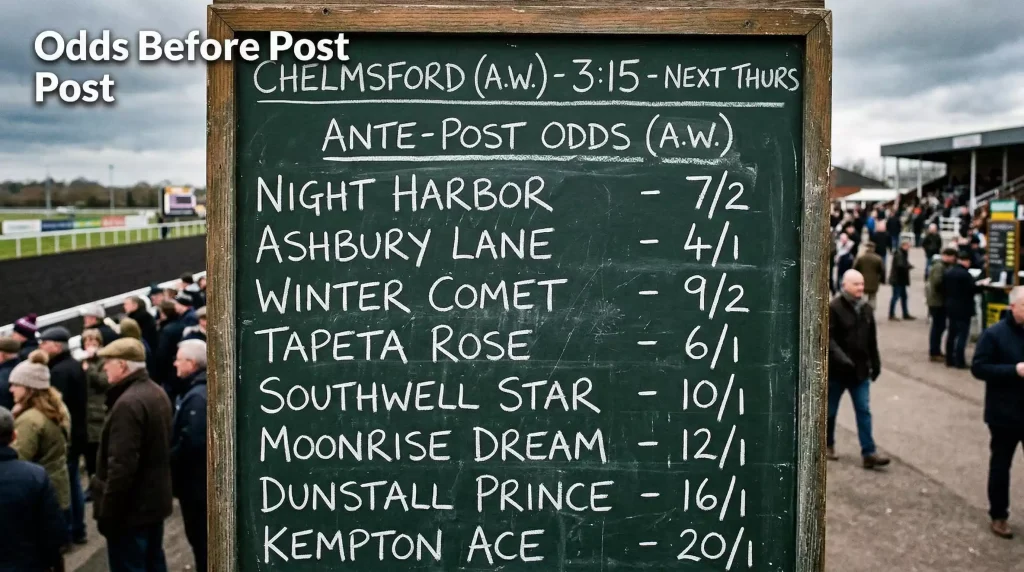
Ante-post betting in all-weather racing occupies an unusual corner of the market. On turf, ante-post is a familiar concept — months before Cheltenham or Royal Ascot, punters take early prices on horses they expect to improve through the season. On the all-weather circuit, the dynamic is different. The Championship programme runs from October to April across more than 200 fixtures, the fields are less predictable weeks in advance and the margins between contenders are often tighter. Ante-post betting here offers genuine value when the conditions are right, but it also carries risks that turf ante-post markets do not.
The essential distinction is structural. Turf ante-post markets are built around fixed-date festivals where the entries are known well in advance and the prize money justifies careful campaign planning. All-weather ante-post markets revolve around Fast Track Qualifiers and a Finals Day that many casual punters barely know exists. That lower profile creates thinner markets, less efficient pricing and — for those who understand the programme — moments where the odds have not caught up with the form.
Ante-Post Betting in All-Weather Racing — More on this topic at southwell betting.
How AW Ante-Post Markets Differ From Turf
The first and most important difference is liquidity. Ante-post markets for the All-Weather Championships Finals Day attract a fraction of the betting volume that Cheltenham Festival markets generate. This means prices can be slow to adjust, overreactions are common and the market can be moved by relatively small amounts of money. For a well-informed bettor placing a modest stake, the ability to influence price is negligible — but the probability of finding a generous price before it shortens is real.
The second difference is the non-runner rate. On turf, a horse entered for a specific festival race may be withdrawn due to ground conditions, injury or a change of plan. On the all-weather, where the surface is consistent and weather-related abandonments are rare, the primary cause of ante-post non-runners is injury or a change of target by the trainer. This makes the non-runner risk marginally lower than on turf — but it still exists, and it is the central risk of all ante-post betting.
The third difference is form trajectory. Turf ante-post markets often trade on potential — horses that have shown promise but not yet proven themselves at the highest level. All-weather ante-post markets are more form-dependent, because the Championship programme unfolds over six months on a stable surface, and by the time Finals Day approaches, most contenders have established a clear performance level. Early-season ante-post bets are therefore more speculative, while bets placed after the January or February qualifiers carry less uncertainty.
Non-Runner Risk and NRNB Terms
Non-Runner No Bet is the term that mitigates the central risk of ante-post betting: paying for a horse that never runs. Some bookmakers offer NRNB on All-Weather Championship markets, particularly as Finals Day approaches. Under NRNB terms, if your selection does not run in the race, your stake is returned — you lose nothing except the opportunity cost of the money being tied up.
The trade-off is price. NRNB prices are shorter than standard ante-post prices, because the bookmaker is absorbing the non-runner risk that the bettor would otherwise carry. The question for each ante-post bet is whether the price differential justifies the risk. On a horse you are confident will run, standard ante-post at a longer price may offer better expected value. On a horse whose participation is uncertain — due to a minor injury, a trainer known for changing plans or a Finals Day entry dependent on qualifying first — NRNB terms are a sensible insurance policy.
One practical point: NRNB markets for all-weather racing tend to open later than those for major turf festivals. Bookmakers wait until the field for Finals Day is clearer before offering NRNB, which means the prices available are already more informed and the value window is narrower. If you want the best ante-post prices, you need to bet before NRNB is offered and accept the non-runner risk. If you want security, you wait for NRNB and accept a shorter price.
A middle path exists for bettors with exchange accounts. Instead of relying on bookmaker NRNB terms, you can back a horse ante-post at a longer price and then lay it on the exchange if information emerges that the horse will not run. The lay price will not recover your full stake — the market will have moved against you — but it limits the downside. This hedge-and-hold approach requires monitoring trainer interviews, gallop reports and entry patterns, but for those who follow the all-weather circuit closely, the information is readily available.
Identifying Ante-Post Value on AW Championship Routes
The All-Weather Championships season spans six tracks and more than 200 fixtures, which creates multiple potential qualification routes for Finals Day contenders. According to the official programme, the participating venues are Chelmsford City, Kempton Park, Lingfield Park, Newcastle, Southwell and Wolverhampton. Fast Track Qualifier winners earn an automatic berth; other horses can qualify on merit through their overall season record.
The value in ante-post markets tends to emerge in two windows. The first is early in the season — October and November — when horses are returning to the all-weather after summer breaks and the form picture is still developing. At this stage, the market relies heavily on last season’s performance, which may not reflect current ability. A horse that has been freshened up over summer and returns in improved condition can offer significant ante-post value before its first qualifying run.
The second window is immediately after a Fast Track Qualifier. A horse that wins impressively at Southwell or Newcastle in January may not have its Finals Day price adjusted quickly enough by bookmakers who underestimate the significance of the qualifier performance. If you watch the qualifier live, assess the form and act before the market settles — often within the first 24 hours — there is a genuine value window.
When to Strike and When to Wait
The Levy yield for 2024/25 reached a record £108.9 million, and part of that income flows into the prize money that makes the All-Weather Championships commercially viable. As the sport invests more in its all-weather shop window, the quality of Finals Day is likely to improve — which means ante-post markets will become deeper and more competitive over time.
See also Front-Runners at Southwell.
For now, the practical advice is to treat all-weather ante-post as a selective discipline. Do not bet early for the sake of it. The best ante-post punters in this space follow four rules: they watch qualifying races in person or on stream rather than relying on form summaries; they assess whether a horse’s running style suits the Finals Day track at Newcastle; they compare the ante-post price with their own assessment of the horse’s chance; and they decide before betting whether they would accept NRNB terms at a shorter price or take the risk at a longer one.
If none of those conditions produces a clear answer, the correct bet is no bet. Ante-post betting rewards conviction, not volume. In a market as thinly traded as the All-Weather Championships, the patient punter has a genuine structural advantage over the one who feels compelled to have an opinion on every race.
